specifically: a stylized representation of a heart
a card decorated with hearts and flowers
2
a
: a playing card marked with a stylized figure of a red heart
b
hearts plural: the suit comprising cards marked with hearts
the five of hearts
c
hearts plural in form but singular or plural in construction: a game in which the object is to avoid taking tricks (see trickentry 1 sense 4) containing hearts
Noun
I could feel my heart pounding.
He has a bad heart.
He put his hand on his heart.
When she heard the news, her heart filled with joy.
She just couldn't find it in her heart to forgive them.
I felt in my heart that our relationship was never meant to be.
a ruler without a heartHave a heart! Can't you see he needs help?
Recent Examples on the Web
Examples are automatically compiled from online sources to
show current usage.Read More
Opinions expressed in the examples do not represent those of Merriam-Webster or its editors.
Send us feedback.
Noun
The publication also calls for better national infrastructure around women’s heart health that includes more training, community engagement and research.—
Helen Carefoot,
Flow Space,
26 Oct. 2026 Research from clinical trials that have required female participants only since 1993 have repeatedly drummed home that message, from varying chromosomes in heart muscle cells to different heart attack symptoms and causes.—
Elizabeth Cooney,
STAT,
26 Oct. 2026 Essentially, that means a blood clot in her leg got loose and traveled to her heart.—
Theresa Clift,
Sacbee.com,
26 Oct. 2026 The Wi-Fi and cell service were pretty much nonexistent, which all but highlighted the fact that the true heart of the home was really the outdoor space.—
Rachel Fletcher,
Condé Nast Traveler,
26 Oct. 2026 See All Example Sentences for heart
Word History
Etymology
Noun and Verb
Middle English hert, from Old English heorte; akin to Old High German herza heart, Latin cord-, cor, Greek kardia
First Known Use
Noun
before the 12th century, in the meaning defined at sense 1a
Verb
before the 12th century, in the meaning defined at sense 2
Time Traveler
The first known use of heart was
before the 12th century
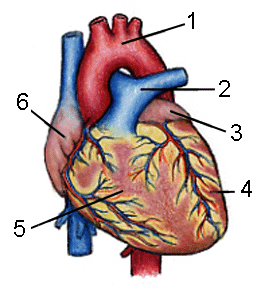
: a hollow muscular organ of vertebrate animals that by its rhythmic contraction acts as a force pump maintaining the circulation of the blood and that in the human adult is about five inches (13 centimeters) long and three and one half inches (9 centimeters) broad, is of conical form, is placed obliquely in the chest with the broad end upward and to the right and the apex opposite the interval between the cartilages of the fifth and sixth ribs on the left side, is enclosed in a serous pericardium, and consists as in other mammals and in birds of four chambers divided into an upper pair of rather thin-walled atria which receive blood from the veins and a lower pair of thick-walled ventricles into which the blood is forced and which in turn pump it into the arteries
2
: a structure in an invertebrate animal functionally analogous to the vertebrate heart


 Copy Citation