Noun (2)
she left only a bit of the broccoli on her plate bits of cookie scattered on the table
I'll have only a bit of food right now
this will only take a bit
known for a comedic bit in which she portrayed a very nervous student driver
wielding silver trays, the servers offered partygoers a variety of exotic-looking bits
Recent Examples on the Web
Examples are automatically compiled from online sources to
show current usage.Read More
Opinions expressed in the examples do not represent those of Merriam-Webster or its editors.
Send us feedback.
Noun
For Rory McIlroy, the trek toward getting a second Masters championship got a little bit harder.—Rod Beard, AJC.com, 12 Apr. 2026 For whatever sprinkling of sociopathy that Quinn might have, seeing her dead best friend’s daughter, who looks just like her best friend, standing in front of her cracks through a little bit.—Max Gao, Variety, 11 Apr. 2026
Verb
The 2014 incident involved a seven-foot-long great white shark that bit a swimmer near Manhattan Beach Pier.—Moná Thomas, PEOPLE, 3 Apr. 2026 Each bonkers bit is a nice reminder not to take anything too seriously.—Ben Travers, IndieWire, 11 Mar. 2026 See All Example Sentences for bit
Word History
Etymology
Noun (1)
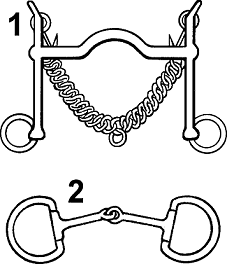
Middle English bite, bit "bite of an animal, cutting edge, point, mouthpiece of a bridle," going back to Old English bite "bite of an animal, cut from a weapon," going back to Germanic *biti- (whence Old Saxon biti "bite, sting," Old High German biz [gebiz "mouthpiece of a bridle"], Old Norse bit), noun derivative from the base of *bītan- "to bite" — more at bite entry 1
Middle English bite, bit "mouthful of food, morsel," going back to Old English bita, bite, going back to Germanic *bitan- (whence Middle Dutch bete "morsel," Old High German bizzo, Old Norse biti), noun derivative from the base of *bītan- "to bite" — more at bite entry 1
Noun (3)
from binary digit
Note:
The term bit was introduced into general circulation by Claude shannon in "A Mathematical Theory of Communication," Bell System Technical Journal, vol. 27, July, 1948, p. 380: "The choice of a logarithmic base corresponds to the choice of a unit for measuring information. If the base 2 is used the resulting units may be called binary digits, or more briefly bits, a word suggested by J.W. Tukey." The American mathematician John W. Tukey (1915-2000) had used the word in a Bell Labs memorandum, "Sequential Conversion of Continuous Data to Digital Data," dated January 9, 1947. Tukey employed bit as a counterpart in a binary system to digit in the decimal system. For details see "The Origin of Bit" in the "Anecdotes" section of Annals of the History of Computing, vol 6, no. 2 (April, 1984), pp. 152-55.
First Known Use
Noun (1)
14th century, in the meaning defined at sense 1a(1)