✨📕 The NEWThe NEW Collegiate Dictionary, 12th Edition Over 5,000 words added — Buy Now! Collegiate DictionaryBuy Now!

their

adjective

t͟hər
ˈt͟her How to pronounce their (audio)
1
: of or relating to them or themselves especially as possessors, agents, or objects of an action
their furniture
their verses
their being seen

Note: Do not confuse their, which has to do with what belongs to or is associated with them, with the words there and they're. There has meanings that mostly relate to a literal or abstract location ("moving away from there," "there it is," "a friend who's there for you"), while they're is a contraction of "they are" ("when they're ready").

2
: his or her : his, her, its
used with an indefinite third person singular antecedent
… anyone in their senses …W. H. Auden
Can they, their, theirs, them, themself, and themselves be used to refer to one person?: Usage Guide

Words like everyone, anyone, and someone are typically understood as singular, which means that logically they should be paired with a singular pronoun like him or her. However, neither of the following examples are acceptable to the modern speaker unless the person referred to is known to be male or known to be female:

Everyone should bring his own pencil.
If someone calls, tell her I'll be back soon.

His or her, him or her, and similar combinations were formerly recommended instead, but widely disliked. Fortunately, a simpler solution is available: they—and the related forms them, their, theirs, and themselves—have done the job for centuries, and are now widely accepted.

"… I would have everybody marry if they can do it properly. …" Jane Austen
"… it never amuses me to see anybody hurt, no matter what hurts them. …" Lucy Maud Montgomery
… And every one to rest themselves betake … William Shakespeare
It drizzled a little, shone a little, blew a little, and didn't make up its mind till it was too late for anyone else to make up theirs. Louisa May Alcott
I forgot all of that. I was only aware that someone had invoked their right over the body of my son. Ta-Nehisi Coates

Additionally, the form themself, which was all but eclipsed by themselves in the late 16th century, has recently seen an increase in use as an alternative to singular themselves.

… the unselfconscious absorption of someone working something out for themself James Lewis Hoberman

They and related forms are also commonly used to refer to someone whose identity is unknown, unspecified, or intentionally not revealed, or to singular nouns that stand for any person or many persons.

The winner will have their artwork placed on display at the U.S. Capitol for the next year. Zach Nunn
"Do you suppose you're the only person who does what they say they're going to do?" Ida Alexa Ross Wylie
No man goes to battle to be killed.—But they do get killed. George Bernard Shaw
I do not believe there is an artist in history who hasn't asked themself—at least once—"Why do I do this?" Mary Gabriel

These forms are also often preferred by those whose gender identity is nonbinary.

… as a nonbinary grad student who uses they/them pronouns … Maddy Shred
… the Grammy-nominated singer and actor, who last year said they are nonbinary … Aidin Vaziri
… uses he and they pronouns and refers to themself as the governor's son … Eduardo Medina and Jacey Fortin

Did you know?

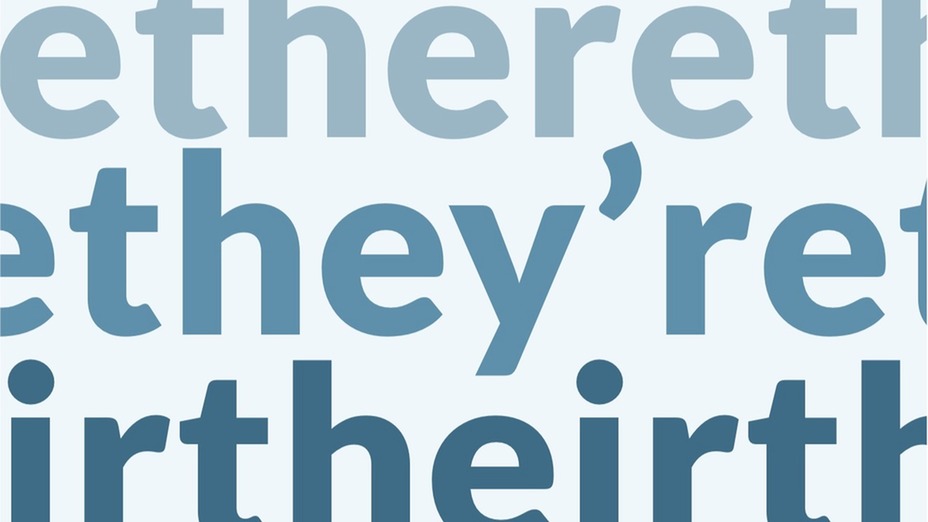
There vs. They're vs. Their

There, they're, and their: they sound the same but have different meanings and keeping them straight can be very tricky.

We'll start with there. It has the word here in it, which can help remind us that this particular word is often about location:

There it is.

Put it there.

Stay there.

We'll be there soon.

It's about location in the more abstract sense too:

There you go.

There is where we disagree.

Friends who are always there for you.

It's also the one to use as the first word in sentences that have the subject after the verb:

There goes the bus.

And it's the one used with is and are at the beginning of sentences and questions:

There are plenty available.

Is there a hotel in the town?

The other two are trickier because they both have the idea of the plural in them. Both are connected to the idea of "them."

They're means "they are":

They're (=they are) funny people.

They're (=they are) the cutest puppies ever.

It can be used of non-living things too:

They're (=they are) both really good books.

They're (=they are) two of our biggest problems.

The last of this trio, their, is the possessive form of they, so it has to do with what belongs to, relates to, or is made or done by certain people, animals, or things:

It's their house.

We're their neighbors.

The trees are losing their leaves.

And there you go. They're not an easy group of words, but with practice we know you can master their distinctions.

Examples of their in a Sentence

All the furniture in their house is brand-new. They are on friendly terms with their neighbors. The students are seeking to exercise their rights. The birds have left their nest. The trees have all shed their leaves. Their artwork is on display at the museum. He was angry because of their arriving late.
Recent Examples on the Web
Examples are automatically compiled from online sources to show current usage. Read More Opinions expressed in the examples do not represent those of Merriam-Webster or its editors. Send us feedback.
Anti-Castro Cuban-Americans hate the idea of U.S. travelers enjoying mojitos in the police state that drove exiles from their homes and businesses. Vivian Salama, The Seattle Times, 2 June 2017 Both had been turned in by a landlord after their owner had been evicted. Sheldon S. Shafer, The Courier-Journal, 2 June 2017 Fidel Castro slowly faded from view, becoming even less coherent, before dying at home in November, as his brother slowly rolled back their revolution. David A. Graham, The Atlantic, 30 May 2017 Several years (and one divorce) later, his kids had moved to New England with their mother. Christopher Borrelli, chicagotribune.com, 28 May 2017 See All Example Sentences for their

Word History

Etymology

Middle English, from their, pronoun, from Old Norse theirra, genitive plural demonstrative & personal pronoun; akin to Old English thæt that

First Known Use

13th century, in the meaning defined at sense 1

Time Traveler
The first known use of their was in the 13th century

Browse Nearby Words

Cite this Entry

“Their.” Merriam-Webster.com Dictionary, Merriam-Webster, https://www.merriam-webster.com/dictionary/their. Accessed 3 Dec. 2025.

Kids Definition

their

adjective
t͟hər How to pronounce their (audio)
(ˌ)t͟he(ə)r
(ˌ)t͟ha(ə)r
: of or relating to them or themselves
their clothes
they all have their theories
their being seen

More from Merriam-Webster on their

Last Updated: - Definition revised
Love words? Need even more definitions?

Subscribe to America's largest dictionary and get thousands more definitions and advanced search—ad free!