Noun (2)
the movie is a rib of the "dramatic love story" that was so popular in the 1950s
began to lose his sense of humor after being the butt of his friends' ribs once too often Verb (2)ribbed him a bit about fumbling such an easy play
Recent Examples on the Web
Examples are automatically compiled from online sources to
show current usage.Read More
Opinions expressed in the examples do not represent those of Merriam-Webster or its editors.
Send us feedback.
Noun
Milne pointed to Goldee’s menu, which offers unique twists to the traditional Texas trinity of barbecue — brisket, ribs and sausage.—Fort Worth Star-Telegram,
8 Oct. 2026 The three-time AL MVP played just seven games after May 31 because of a fractured rib and the leg injury, an absence the team couldn't overcome.—CBS News,
8 Oct. 2026
Verb
Happy hour at home gets a designer twist with these trendy ribbed tumblers that can sport salt rims for margaritas and stack neatly on your bar cart.—
Audrey Lee,
Architectural Digest,
6 Oct. 2026 Fellow Knicks starters Karl-Anthony Towns, Mikal Bridges, OG Anunoby, and Josh Hart are called on from the audience for some light ribbing, then join Brunson on the stage.—
Andy Hoglund,
Entertainment Weekly,
27 Sep. 2026 See All Example Sentences for rib
Word History
Etymology
Noun (1)
Middle English, from Old English ribb; akin to Old High German rippi rib, Old Church Slavic rebro, and probably to Greek erephein to roof over
Verb (2) and Noun (2)
probably from rib entry 1; from the tickling of the ribs to cause laughter
First Known Use
Noun (1)
before the 12th century, in the meaning defined at sense 1a
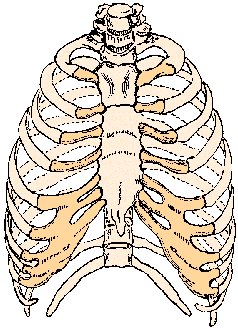
: one of the series of curved bones of the chest of most vertebrates that are joined to the spinal column in pairs and help to support the body wall and protect the organs inside
b
: a cut of meat including a rib
2
: something (as a piece of wire supporting the fabric of an umbrella) resembling a rib
3
a
: a major vein of an insect's wing or of a leaf
b
: one of the parallel ridges in a knitted or woven fabric
: any of the paired curved bony or partly cartilaginous rods that stiffen the lateral walls of the body of most vertebrates and protect the viscera, that occur in mammals exclusively or almost exclusively in the thoracic region, and that in humans normally include 12 pairs of which all are articulated with the spinal column at the dorsal end and the first 10 are connected also at the ventral end with the sternum by costal cartilages see false rib, floating rib, true rib


 Copy Citation