: a high ecclesiastical official of the Roman Catholic Church who ranks next below the pope and is appointed by him to assist him as a member of the college of cardinals (see collegesense 6)
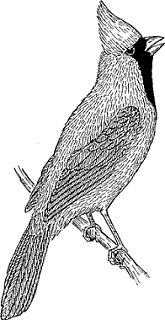
[from its color, resembling that of the cardinal's robes]: a crested finch (Cardinalis cardinalis of the family Cardinalidae) of the eastern U.S. and adjacent Canada, the southwestern U.S., and Mexico to Belize which has a black face and heavy red bill in both sexes and is nearly completely red in the male
b
: any of several red-headed passerine birds (genus Paroaria of the family Thraupidae) of South America and the West Indies that are grayish to blackish above with white underparts
Mathematics, religion, ornithology—everything seems to hinge on cardinal. As a noun, cardinal has important uses in all three of the aforementioned realms of human inquiry; as an adjective cardinal describes things of basic or main importance, suggesting that outcomes turn or depend on them. Both adjective and noun trace back to the Latin adjective cardinalis, meaning “serving as a hinge,” and further to the noun cardo, meaning “hinge.” Since the 12th century, cardinal has been used as a noun referring to a fundamentally important clergyman of the Roman Catholic Church, ranking only below the pope. (The clergyman's red robes gave the familiar North American songbird its name.) By the 1300s cardinal was also being used as the adjective we know today, to describe abstract things such as principles or rules (as opposed to, say, red wheelbarrows) upon which so much depends.
Examples of cardinal in a Sentence
The Pope appointed two new cardinals this year.
Recent Examples on the Web
Examples are automatically compiled from online sources to
show current usage.Read More
Opinions expressed in the examples do not represent those of Merriam-Webster or its editors.
Send us feedback.
Leo broke with Vatican tradition by personally presenting it at Monday's press conference—a task typically delegated to cardinals—and invited Olah to share the stage in what Vatican observers described as a bid to engage the people building the technology directly.—Alicia Park, Forbes.com, 25 May 2026 Past popes have normally handed that role of presenting an encyclical to cardinals or other senior figures.—Christopher Lamb, CNN Money, 25 May 2026 Two of its top cardinals, doctrine chief Cardinal Víctor Manuel Fernández and development chief Cardinal Michael Czerny, will be the main presenters.—ABC News, 18 May 2026 Safe Haven depicts three children playing under a squirrel, a cardinal and an owl while under a tree with leaves falling upon them.—Cam'ron Hardy, Chicago Tribune, 14 May 2026 See All Example Sentences for cardinal
Word History
Etymology
Middle English, from Anglo-French, from Medieval Latin cardinalis, from Late Latin cardinalis, adjective — see cardinalentry 2
First Known Use
before the 12th century, in the meaning defined at sense 1
Time Traveler
The first known use of cardinal was
before the 12th century
Middle English cardinal "high church official," from Latin cardinalis (same meaning), from cardinalis (adjective) "principal, most important, of a hinge," from cardo "hinge"
Word Origin
Our word cardinal can be traced back to the Latin adjective cardinalis, which at first meant "serving as a hinge." The root of this word is the noun cardo, meaning "hinge." Since a hinge is the device on which a door turns, the noun cardo also came to be used for "something on which a development turns or depends," or in other words, "something very important." Following this, the adjective took on the meaning "very important, chief, principal." Later the Roman Catholic Church applied this adjective in referring to principal churches and priests. By the late Middle Ages cardinalis had come to be used for "a clergyman of the highest rank, next to the pope." When borrowed into English, cardinalis became cardinal. Then other senses of the word developed. A cardinal's robes are a deep red color, and this color influenced the naming of a type of bird whose color was like that of a cardinal's robes.