: any of a genus (Platanus of the family Platanaceae, the plane-tree family) of chiefly deciduous trees with large palmately lobed leaves, flowers in globose heads, and usually scaling bark
level, flat, plane, even, smooth mean having a surface without bends, curves, or irregularities.
level applies to a horizontal surface that lies on a line parallel with the horizon.
the vast prairies are nearly level
flat applies to a surface devoid of noticeable curvatures, prominences, or depressions.
the work surface must be flat
plane applies to any real or imaginary flat surface in which a straight line between any two points on it lies wholly within that surface.
the plane sides of a crystal
even applies to a surface that is noticeably flat or level or to a line that is observably straight.
trim the hedge so it is even
smooth applies especially to a polished surface free of irregularities.
a smooth skating rink
Examples of plane in a Sentence
Noun (1)
a plane flew overhead Verb (1)planed the wood for the picnic table perfectly smooth so that no one would get splintersVerb (2)
an eagle planed effortlessly overhead, gliding on an air current Adjective
you can do these tracings on any plane surface
Recent Examples on the Web
Examples are automatically compiled from online sources to
show current usage.Read More
Opinions expressed in the examples do not represent those of Merriam-Webster or its editors.
Send us feedback.
Noun
The survival thriller sees Pitt, a former Army Special Forces soldier, who must find a way back to civilization after his small plane crashes deep in the Alaskan wilderness.—
John Hopewell,
Variety,
24 Aug. 2026 The group who refused to get off the plane in Liberia on Thursday include four Cuban men, a Brazilian man and a Cameroonian woman, the person and lawyer said.—
Mark Banchereau,
Los Angeles Times,
24 Aug. 2026 Investigators with the Federal Aviation Administration on Sunday were examining the wreckage of a small plane that crashed in the ocean off Boca Raton a day earlier.—
Cindy Krischer Goodman,
Sun Sentinel,
23 Aug. 2026 Then Bill Eppridge, the photographer, went up, pointed to me, went into the plane, the door closed, and takes off into the night.—ABC News,
23 Aug. 2026 See All Example Sentences for plane
Word History
Etymology
Noun (1)
Latin planum, from neuter of planus level
Verb (1)
Middle English, from Anglo-French planer, from Late Latin planare, from Latin planus level — more at floor
Noun (2)
Middle English, from Anglo-French, from Late Latin plana, from planare
Noun (3)
Middle English, from Anglo-French, from Latin platanus, from Greek platanos; probably akin to Greek platys broad — more at place
Verb (2)
Middle English, from Middle French planer, from plain level, plain
Middle English planen "to make smooth or level," from early French planer (same meaning), derived from Latin planus "level" — related to plainentry 1
Adjective
from Latin planus "level"
Verb
from French planer "to fly while keeping the wings motionless," from plain "level, plain"; so called from the fact that the wings of a soaring bird form a level surface
: a surface that contains at least three points not all in a straight line and is such that a line drawn through any two points in it lies wholly in the surface


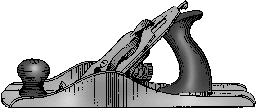
 Copy Citation