: a solid generated by rotating a right triangle about one of its legs
called alsoright circular cone
b
: a solid bounded by a circular or other closed plane base and the surface formed by line segments joining every point of the boundary of the base to a common vertex see Volume Formulas Table
c
: a surface traced by a moving straight line passing through a fixed vertex
2
a
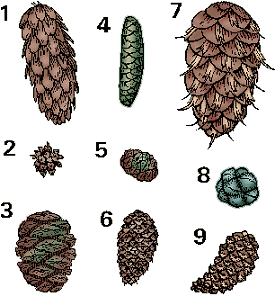
: a mass of ovule-bearing or pollen-bearing scales or bracts in most conifers or in cycads that are arranged usually on a somewhat elongated axis
b
: any of several flower or fruit clusters suggesting a cone
3
: something that resembles a cone in shape: such as
a
: any of the conical photosensitive receptor cells of the vertebrate retina that function in color vision compare rodsense 3
b
: any of a family (Conidae) of tropical marine gastropod mollusks that inject their prey with a potent toxin
c
: the apex of a volcano
d
: a crisp usually cone-shaped wafer for holding ice cream
Noun
He scooped out the popcorn with a paper cone.
Recent Examples on the Web
Examples are automatically compiled from online sources to
show current usage.Read More
Opinions expressed in the examples do not represent those of Merriam-Webster or its editors.
Send us feedback.
Noun
Popo would lick her cone ever so gracefully, never dripping or messing up the lining of her magenta lipstick.—Literary Hub,
16 Oct. 2026 After all, a flat sheet of paper can easily be rolled into a cone or a cylinder.—
Manon Bischoff,
Scientific American,
13 Oct. 2026 Purple coneflowers produce high-fat, protein-rich seeds on stiff cones that maintain their shape despite harsh weather.—
Karen Hugg,
Washington Post,
11 Oct. 2026 DeSantis also warned residents far outside the cone to watch for tornadoes, which can spawn before the core of Isaias moves ashore.—
Alex Harris,
Miami Herald,
9 Oct. 2026 See All Example Sentences for cone
Word History
Etymology
Noun
borrowed from Middle French & Latin; Middle French, "cone in geometry," borrowed from Latin cōnus, borrowed from Greek kônos "pine cone, cone in geometry," probably of pre-Greek substratal origin
: a mass of overlapping woody scales that especially in the pines and other conifers are arranged on a structure like a stem and produce seeds between them
also: any of several flower or fruit clusters resembling such cones
2
a
: a solid figure formed by rotating a right triangle about one of its legs
called alsoright circular cone
b
: a solid figure that slopes evenly to a point from a usually circular base
3
: something shaped like a cone: as
a
: any of the cells of the retina that are sensitive to light and function in color vision


 Copy Citation