: either of two large semiaquatic herbivorous rodents comprising a family (Castoridae including Castor canadensis of North America and C. fiber of Eurasia), having webbed hind feet and a broad flat scaly tail, and constructing dams and partially submerged lodges
Verb
he's been beavering away at the various courses for his dinner party all day long, hoping to impress his new friends
Recent Examples on the Web
Examples are automatically compiled from online sources to
show current usage.Read More
Opinions expressed in the examples do not represent those of Merriam-Webster or its editors.
Send us feedback.
Noun
The preferred method of managing beaver is not to hunt or trap them.—
Andrew McKean,
Outdoor Life,
15 Oct. 2026 The beavers have built a lodge roughly 6 feet high, with an underwater entrance connecting it to the lagoon.—CBS News,
6 Oct. 2026 In winter, several migratory duck species spend the season on its clear-flowing creeks and ponds, including beaver ponds.—
Charles Seabrook,
AJC.com,
3 Oct. 2026 The beavers can't talk, and the trees can't see, and the river only flows in one direction.—
Corey Seymour,
Vogue,
29 Sep. 2026 See All Example Sentences for beaver
Word History
Etymology
Noun (1)
Middle English bever, from Old English beofor; akin to Old High German bibar beaver, and probably to Old English brūn brown — more at brown
Noun (2)
Middle English baviere, from Middle French
First Known Use
Noun (1)
before the 12th century, in the meaning defined at sense 1a
: a large plant-eating rodent that has webbed hind feet and a broad flat tail and that builds dams and houses of mud and branches which are partly underwater
2
: the fur of a beaver
beaver
2 of 2noun
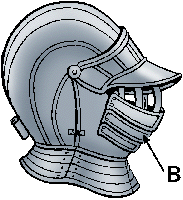
: a piece of armor protecting the lower part of the face


 Copy Citation