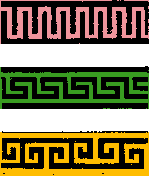
: to press (the strings of a stringed instrument) against the frets
Did you know?
Fret and Eating
Fret not about being unfamiliar with the history of the verb fret; we’ve got something for you to chew on. While fretting today usually involves a concern that is figuratively eating at someone, fret has older senses that apply to literal eating. Fret comes from the Old English verb fretan, “to devour,” which shares an ancestor with another verb, etan, the ancestor of eat. In centuries past, animals—or monsters, in the case of Grendel—were said to fret, as were substances that corrode, or eat away, at other substances. But it wasn’t long before fret was also applied to emotional experiences, as when someone frets over an all-consuming thought or trouble. While fret still carries the meanings of “to corrode,” “to fray,” and “to chafe,” among others, one is most likely to encounter its more angsty sense of “to worry or be concerned.”
Verb (1)
over the span of thousands of years, the annual spring runoff fretted the rock, forming a deep channel
don't let the girth fret the horse's belly or you won't be able to ride him
don't fret over whether it will be sunny tomorrow, as there's nothing we can do about it
the stiff, starchy collar was fretting my neck, and I couldn't wait to change out of that costume Noun (1)
one of my customers always gets into a fret if I'm so much as 15 minutes late delivering his newspaper
Recent Examples on the Web
Examples are automatically compiled from online sources to
show current usage.Read More
Opinions expressed in the examples do not represent those of Merriam-Webster or its editors.
Send us feedback.
Verb
Still, shares of Alphabet fell 3% in after-hours trading on Wednesday, as investors fretted about the company’s rising capital expenditures (up to $205 billion in 2026 spending) and fierce competition facing its Gemini family of AI models.—
Andrew Nusca,
Fortune,
23 July 2026 Energy markets, already worried by the resumption of hostilities, now have another thing to fret over.—
Lim Hui Jie,
CNBC,
23 July 2026
Noun
Where the familiar Western music scale has 12 notes in an octave, each note a half-tone step from the next, his instruments go to 24, each regular fret split by another, making quarter-tones.—
Steve Hochman,
SPIN,
15 July 2026 The viol family included larger instruments known as viols da gamba, which were played between the legs and often featured frets similar to those found on guitars.—Encyclopedia Britannica,
8 July 2026 See All Example Sentences for fret
Word History
Etymology
Verb (1) and Noun (1)
Middle English, to devour, fret, from Old English fretan to devour; akin to Old High German frezzan to devour, ezzan to eat — more at eat
Verb (2)
Middle English, back-formation from fret, fretted adorned, interwoven, from Anglo-French fretté, past participle of fretter to tie, probably from Vulgar Latin *firmitare, from Latin firmus firm
Noun (3)
perhaps from Middle French frete ferrule, from freter