Noun
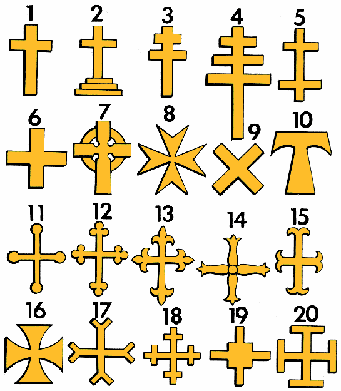
a necklace with a gold cross
The teacher marked the absent students on her list with crosses.
Those who could not write signed their names with a cross. Verb
We crossed the state border hours ago.
The dog crossed the street.
The highway crosses the entire state.
He was the first runner to cross the finish line.
The train crosses through France.
Put a nail where the boards cross.
One line crossed the other. Adjective
I didn't mean to make you cross.
I was cross with her for being so careless.
Recent Examples on the Web
Examples are automatically compiled from online sources to
show current usage.Read More
Opinions expressed in the examples do not represent those of Merriam-Webster or its editors.
Send us feedback.
Noun
Bruno Guimaraes scored with a header from the cross back in.—Liam Tharme, New York Times, 12 Dec. 2025 Weeks after the initial complaint was filed in May, Robinson filed a $500 million cross-complaint that accused the plaintiffs and their legal counsel of defaming him at a press conference.—Rachel Desantis, PEOPLE, 10 Dec. 2025
Verb
On December 11, one of the only 174 examples of the model ever made will cross the auction block through Bonhams.—Viju Mathew, Robb Report, 10 Dec. 2025 Either way, these ancient humans were skilled foragers and hunter-gatherers who lived in small groups of perhaps a dozen people and only rarely crossed paths with other bands.—Meghan Bartels, Scientific American, 10 Dec. 2025 See All Example Sentences for cross
Word History
Etymology
Noun, Verb, Adjective, Preposition, and Adverb
Middle English, from Old English, from Old Norse or Old Irish; Old Norse kross, from Old Irish cros, from Latin cruc-, crux
First Known Use
Noun
before the 12th century, in the meaning defined at sense 1a
Old English cros, probably from an early Norse or an early Irish word derived from Latin crux "cross" — related to crucial, cruise, crusade, crux, excruciating



 Copy Citation


Share