
Many English words have origins in Greek, but only a small number of those borrowings come from Greek mythology. With the release of a new movie adaptation of one of the great Greek epics, let’s look at a few of these, starting with the word epic itself.
The word was first used in English in 1583, the height of the Renaissance, appropriately enough, the period when the literature and language of ancient cultures was rediscovered, reappraised, and republished (that’s what the “rebirth” was all about). Epic comes from a Greek word that can mean “poem,” “word,” or “speech”; it passed through Latin on its way to English.
Epic initially only referred to the long ancient narrative poems that recount the deeds of a legendary or historical hero, like the Odyssey and the Iliad (from the Ancient Greek of Homer) or the Aeneid (from the Classical Latin of Vergil).
By the late 1700s, epic could refer to any long work that resembled the original epics in some way. Using epic as an emphatic and casual adjective meaning “extraordinary” or “impressive” (“epic failure,” “epic showdown”) is a much more recent development, dating back only to the early 1980s.
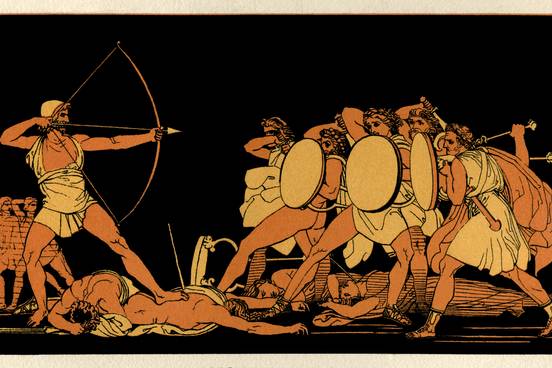
Odyssey has come to mean “a long journey full of adventures” in a general way, but its origin is specific to the adventures of a single personage: Odysseus. The Odyssey is an epic tale of the difficult ten-year return to Ithaca by Odysseus after the fall of Troy. It’s one of the oldest known works of literature, written in Ancient Greek, and dating to perhaps 700 BC. It is attributed to Homer, though details of his life and authorship are uncertain.
The tribulations of the voyage include storms at sea and interference by various gods of the Greek pantheon, including Athena, Zeus, Hermes, and Poseidon. Use of odyssey to refer to anyone’s journey or quest dates only to the late 1800s in English, but the word was already found in Old English as the title of the epic poem.
Odyssey is an eponym, a word based on a name. It has been traditional to associate the punishing long trip home of Odysseus with an explanation of the origin of his name as one “hated by gods and men,” which would connect it with odium (“hatred”) and odious (“hateful”), words that came to English from Latin but ultimately derived from Greek.
There’s no way to prove this connection, however, so this etymology remains just a good story, like the epic itself.

Siren is one of the few words that comes directly from the text of the Odyssey. In the epic, a siren is “any of a group of female and partly human creatures in Greek mythology that lured mariners to destruction by their singing.” Odysseus blocked the ears of his ship’s crew with wax so that they couldn’t hear the magical song of the sirens that would make them crash their ship on the rocks near where the voices were coming from. He then had himself tied to the mast so that he couldn’t succumb to the desire.
A siren song is consequently defined as “an alluring utterance or appeal especially : one that is seductive or deceptive.”
Today’s more common use of siren, to refer to a piercing sound of warning that we hear from police cars and fire trucks, dates to the late 1800s.
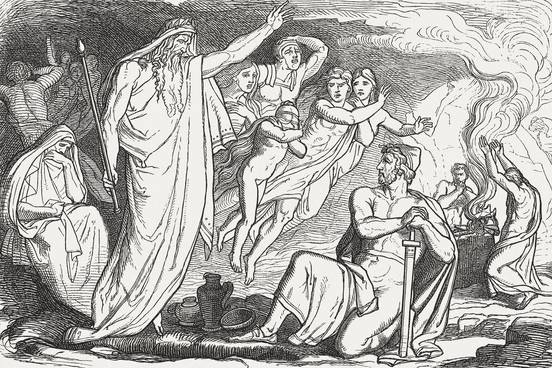
Necromancy is another word that comes to us straight from the text of the Odyssey itself. More precisely, it is the anglicized form of necromantīa, the Latin translation of the title of Chapter XI, usually rendered in English as something like “The Visit to the Dead” or “Odysseus Visits the Land of the Dead.”
The Latin word came from two Greek words put together, starting with nekrós, which meant "dead body," or, in the plural, “spirits.” This root is seen as part of a few other English words: a necropolis is a cemetery and a necrology is an obituary.
The second part of this word derives from mantis, the Greek word for “diviner” or “prophet,” which is also the root for the name of the insect that holds its forelimbs up as if it were praying.
Necromancy means “conjuration of the spirits of the dead for purposes of magically revealing the future or influencing the course of events.” It’s also a synonym of magic or sorcery, and this is the way it’s most commonly used today, often in a figurative way to describe something that is too complicated for most people to understand, and sometimes preceded by digital, political, or legal, as a more fancy way to say “magic.”

Calypso is the name of the nymph (a kind of semi-divine or godlike spirit, usually taking the form of a beautiful maiden) who held Odysseus captive for seven years. During that time, Odysseus built a wooden boat on Calypso’s island in order to sail home to Ithaca.
The famous oceanographer Jacques Cousteau’s research ship was named Calypso, making it a familiar name associated with seagoing vessels in the 20th century. (It’s also the title of a song dedicated to Cousteau by John Denver.)
The connection with the infectious rhythms of Caribbean music is less clear, however. This kind of music originated in Trinidad, and while there are associations with islands and water in Caribbean culture generally, it is assumed that this use of calypso simply came about from its resemblance to kaiso, the word of African origin that designated this kind of music.
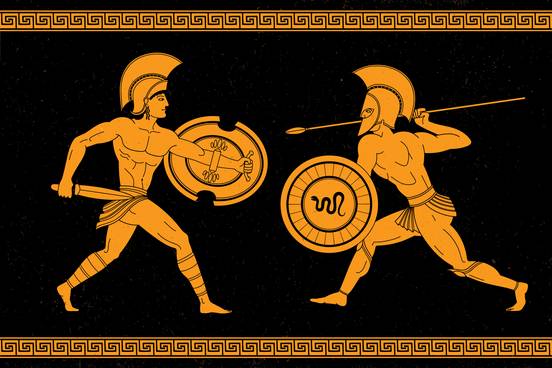
Hector is the Trojan warrior who was killed in single combat by the Greek hero Achilles, a story recounted in the Iliad. Since the Odyssey takes place some ten years after the events of the Iliad, Hector is only mentioned in a few reminiscences and references in the latter epic. But his name, like that of Mentor, has become a noun and then a verb in English with meanings that reflect personality traits of their characters.
Hector's reputation as a great fighter led to the use of his name by violent London street gangs in the 17th century. These criminals wanted to add a sheen of myth and intimidation to their activities, and this appropriation by bullies resulted in his name became a noun meaning “bully” or “braggart” in English dating to the mid-1600s. The verb hector, meaning “to intimidate or criticize in a threatening way” followed soon after, and is the more common way the word is used today.

Epithet connects with Homer’s epics by way of association. Yes, the word derives from the Greek verb meaning “to put on” or “to add,” but in today’s English epithet means “a word or phrase that describes a person or thing” or “an offensive word or name.”
In the Odyssey, epithets are descriptions of the person or thing and are often cited with each mention; references to the sea are usually as “the wine dark sea,” for example. Another epithet that provides a vivid poetic image is “rosy-fingered dawn.”
Homer used them with the names of prominent characters, such as Swift-footed Achilles and Gray-eyed Athena. Epithets certainly exist outside the world imagined by Homer’s epics, too, and are familiar to us as ways to identify historical figures such as Alexander the Great, Richard the Lionheart, or William the Conqueror.

One stop on Oysseus’ return voyage was an island populated by people who ate local plants as a kind of delicacy. The plants—assumed by historians to be opium—caused the inhabitants to be peaceful, dreamy, and indolent.
By the mid-1800s, lotus-eater was used more broadly to refer to daydreamers and untroubled, indolent, or docile pleasure-seeking people.

On his journey home, Odysseus encounters a terrifying giant, the Cyclops named Polyphemus, son of the sea god Poseidon. Our hero and his men are taken captive and several of the men are eaten by the giant. The Cyclops has only one eye in the center of its forehead, and this distinguishing feature has led cyclops to be used for various one-eyed crustaceans, one-lensed cameras, single-source lights, and, oh yes, a character in the Marvel X-Men franchise.

During Odysseus’ visit to Hades, he sees Tantalus, a former king, standing chin-deep in a pool of water with fruit tree branches just above him. But whenever Tantalus tries to drink the water, the level recedes out of his reach, and whenever he tries to grab a piece of fruit, the branches rise too high to grasp.
This punishment was the result of revealing the secrets of the gods, and led to the verb tantalize, meaning “to tease or torment by or as if by presenting something desirable to the view but continually keeping it out of reach."

A mentor is “a person who gives help and advice to a less experienced and often younger person especially in a professional or academic context,” and it comes from the name of a character in the Odyssey who exemplifies this role.
The character Mentor is a friend of Odysseus who is entrusted with the education of Odysseus' son Telemachus. The 1699 novel The Adventures of Telemachus, Son of Ulysses (Ulysses is the Latin form of the name Odysseus) by François Fénelon made Mentor the central character, and the popularity of this more modern work led to the current use of mentor.

Homer’s influence is so great that his name has been adapted as an adjective, Homeric, to describe both the works themselves and their style (“Homeric epics,” “Homeric language”) and, more broadly, to mean “heroic” or “of epic proportions” (“a Homeric space voyage,” “Homeric boasting”).
The names of Ancient Greek philosophers that have become adjectives are also frequently encountered: Platonic and Socratic.
Other adjectives derived from authors’ names in the dictionary include Shakespearean, Proustian, Dickensian, and Kafkaesque.
The name in ancient Greek for Greece was Hellas, which is the origin of the words Hellenistic, Hellenism, and Hellenist. Hellenistic means “of or relating to Greek history, culture, or art after Alexander the Great,” or after around 323 BC. Hellenist can refer either to people who adopted the Greek language in that historical period or to someone today who studies the language and culture of ancient Greece.
The fact that this word resembles the name Helen, as in Helen of Troy, the Greek queen who followed (or was abducted by, depending on the interpretation of the myth) the Trojan prince Paris to Troy, triggering the Trojan War depicted in the Iliad and the Odyssey, is just a coincidence.