The Words of the Week - Sept. 25
Dictionary lookups from weather, colors, and Fat Bear Week
A news story about news organizations suspending their participation in the White House pool led to increased lookups for pool.
The five networks that have suspended their pool coverage of President Trump—ABC, CBS, CNN, Fox News, and NBC—just issued a joint statement: “The public has a vital interest in receiving accurate, independent information about its government. No administration should restrict a news organization because it objects to its reporting.”
—Michael Grynbaum, The New York Times, 21 Sept. 2026
We define the relevant sense of pool, used attributively in the New York Times quote, as “a group of journalists from usually several news organizations using pooled resources (such as television equipment) to produce shared coverage especially of events to which access is restricted.” This pool is etymologically distinct from the water-related pool. That pool traces back to the Old English word pōl, referring to a small and rather deep body of usually fresh water. The journalistic pool has a more surprising origin: the French word poule meaning, literally, “hen.” This pool was first used in the early 18th century to refer, in the context of a game, to an aggregate stake—like an ante—to which each player has contributed.
The fall equinox occurred this year on Tuesday, corresponding with an uptick in lookups for equinox.
Autumn lovers rejoice. Summer is winding down as the fall equinox is finally here. While fall and Halloween decor have already hit many store shelves and pumpkin spice lattes are being served in coffee shops across the nation, the equinox marks the first official day of the fall season.
—
There are two equinoxes: the autumnal (fall) and the vernal (spring). They are the times each year (about March 21 and September 23) when the sun crosses the equator and day and night are everywhere on earth of approximately equal length. The etymology of the word matches its meaning nicely: equinox comes from aequus, the Latin word for “equal” or “even,” and nox, the Latin word for “night.”
The adjective rotund is a Word of the Week this week, owing to Fat Bear Week.
After a summer spent packing away sockeye salmon, Alaska’s heftiest brown bears are ready to throw their weight around. Online voting began Tuesday for Fat Bear Week, the annual contest that pits the rotund residents of Katmai National Park and Preserve against each other for the title …
—
We define the relevant sense of rotund as a synonym of chubby meaning “notably plump.” The word comes from the Latin adjective rotundus, which is thought to share an older ancestor with rota, the Latin word for “wheel.” Another rotundus descendant is rotunda, which may refer to a large round room, a large central area (as in a hotel), or a round building—especially one covered by a dome.
Lookups for El Niño were higher than usual this week.
Gov. Gavin Newsom proclaimed a state of emergency Monday in California in preparation for what state officials say could be a historic El Niño season, directing agencies to stage equipment, protect infrastructure and prepare communities for severe winter weather. The looming El Niño event is already breaking records, and forecasters expect it to continue to strengthen, potentially becoming the strongest in recorded history.
—
Each year around Christmas time, a warm equatorial current flows southward along the coast of Peru. In the 19th century, Peruvian fishermen named that annual current “El Niño” in honor of the infant Jesus (el niño means “the child” in Spanish). Later, when scientists noted that in some years this warm current flow is more intense than usual, they adopted the name and applied it to that more potent but erratic climatic phenomenon. Now El Niño is used almost exclusively for the severe episodes (which prevent upwelling of nutrient-rich cold deep water and disrupt typical regional and global weather patterns) rather than for the annual ones to which it was originally applied.
Lookups for the verb annihilate have been high all week following President Trump’s use of the word in a speech at the United Nations General Assembly.
Iran’s president said Wednesday that his people have been “victims of terrorism” by the United States, delivering a rare wartime speech at U.N. General Assembly a day after President Donald Trump said he could “annihilate” the Islamic republic.
—
We define many senses of annihilate, including “to cause to cease to exist : to do away with entirely so that nothing remains” and “to destroy a considerable part of.” The word traces back to the Late Latin verb annihilare, “to reduce to nothing,” from the Latin ad- + nihil, meaning “nothing.”
Lookups for the adjective meretricious spiked after a New York Times columnist used the word, as well as its relative meretrix, and linked to the Merriam-Webster Unabridged definition of the latter. Both words were among the top ten most looked up words.
The word for everything Trump does is “meretricious,” whose Latin root, meretrix—you can look it up—gets at the fundamental vulgarity of his tastes.
—
We define the relevant sense of meretricious as “tastelessly showy and falsely attractive.” Meretricious can be traced back to the Latin verb merēre, meaning “to earn, gain, or deserve.” It shares this origin with a small group of other English words, including merit, meritorious, and emeritus. But, while these words can suggest some degree of honor or esteem, meretricious is used to suggest pretense, insincerity, and cheap or tawdry ornamentation. The Latin merēre is at the root of the Latin noun meretrīx, referring to a sex worker, and the related adjective meretrīcius. Latin meretrīcius entered into English as meretricious in the 17th century.
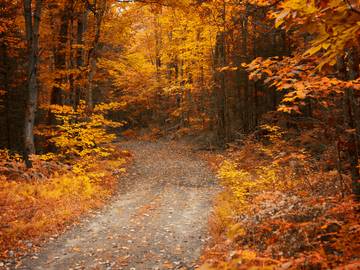
Orange? Yawn. Yellow? Boring. Red? Zzzzzzz. This fall, it’s time to add some (pumpkin) spice to your autumnal color vocabulary. Sure, there’s crimson, scarlet, and russet, but we invite you to dig deeper, so deep in fact that you hit leather lake. Now, leather lake isn’t made out of leather, nor is it a body of water (the lake in question refers to a pigment); rather, it’s a special, third thing: “a brownish orange that is deeper and slightly redder than leather, yellower and deeper than spice, and yellower and deeper than gold pheasant.” Got that? If you’re not hell-bent for leather lake, not to worry: the word has many synonymous alternatives, including autumn leaf, dead leaf, foliage brown, oakleaf brown, withered leaf, philamot, and feuille morte.
Until the introduction of the coal-tar dyes, lakes were made from the natural dyestuffs … many of which are still in the market, and known by such names as crimson lake, berry yellow, madder lake, Dutch pink, rose lake, leather lake, etc. …
—