The Words of the Week - Jul 17
Dictionary lookups from Hollywood, Yellowstone, and Liverpool
A regulatory change involving the Endangered Species Act rested heavily on the definition of the word harm, which led to a rise in lookups for the word.
Under the rule change, the Interior Department removed the definition of “harm” under the Endangered Species Act. Since 1981, “harm” has been defined as any action that hurts or kills species, including modifying or degrading an imperiled species’ habitat. In a move finalized Friday, the administration now leaves “harm” undefined, meaning destroying a species’ nest or habitat would no longer be considered illegal. That would open up animals’ habitats to farming, drilling, mining, real estate development and other activities.
—Jeff Mordock, The Washington Times, 13 July 2026
Harm is used as both a noun and a verb in English. As a noun, as in the quote above, the relevant sense is “physical or mental damage.” The verb harm means “to damage or injure physically or mentally : to cause harm to.” Both noun and verb have been used in English since before the 12th century with those meanings; they come from the Old English hearm, which shares an even older ancestor with the Old Church Slavic word sramŭ, meaning “shame.”
Lookups for the adjective avuncular were higher than usual this week, perhaps due to its use in an article about the life and career of the late actor Sam Neill.
Mr. Neill first came to international attention with the 1979 Australian period drama “My Brilliant Career” playing a frontier rancher. Critics heralded him for nuanced portrayals, describing his “cryptic brusqueness” in one role and his “avuncular suavity tinged with a dignified sadness” in another.
—
We define the relative sense of avuncular as “suggestive of an uncle especially in kindliness or geniality.” Avuncular comes from the Latin noun avunculus, which means “maternal uncle,” but since at least the 19th century English speakers have used avuncular to describe uncles from either side of the family, or people who are uncle-like in character or behavior. Avunculus is also an ancestor of the word uncle itself.
A story about a bison tossing a man into the air in Yellowstone National Park (he survived with serious injuries) coincided with a rise in lookups for bison.
An elderly Yellowstone National Park tourist was caught on video running from and being flung high into the air late Friday by an angry bison.
—
Bison (plural bison) may refer to any of several large living or extinct bovine mammals of the genus Bison. In the Yellowstone story, it refers specifically to the American bison, which we define as “a large North American bison (Bison bison) that has a dense coat of dark brown fur with a shaggy mane on the head and lower neck, short hollow horns, and heavy forequarters with a large muscular hump over the shoulders and that formerly was abundant in North America but is now reduced to small populations of plains and prairies chiefly of the central U.S. and Canada.”
The word bison is of Germanic origin, and shares an ancestor with the Old High German word wisant, referring to the aurochs, an extinct wild ox of Europe that is the ancestor of domestic cattle. Wisant is the ancestor of the word wisent, referring to the European bison.
The demonym Scouser was trending over the weekend, possibly in relation to a UFC fighter from Liverpool who won his own match and then attended another.
Paddy Pimblett called out Conor McGregor among other top fighters on Saturday night after sealing a stunning submission of Benoit Saint-Denis. … The Scouser sung Jota’s “Number 20” chant and urged all Liverpool fans in the crowd to join in. However, his callout of the Irish former two-division champion would age poorly with McGregor suffering a serious knee injury seconds into his comeback bout …
—
We define Scouser as “a native or inhabitant of Liverpool, England.” It has been used slangily for Liverpudlians since the mid-20th century, and traces back to lobscouse, a fab word (if we do say so) for “a sailor’s dish of stewed or baked meat with vegetables and hardtack.”
An outbreak of cyclospora has prompted higher-than-usual lookups for the word cyclospora.
Spread through contaminated food or water and treatable with antibiotics, cyclospora can cause weeks of explosive diarrhea, cramping, nausea, and fatigue, according to the state’s Department of Public Health.
—
Cyclospora refers to any of a genus (Cyclospora of the order Coccidia) of sporozoans including one (C. cayetanensis) causing diarrhea in humans.
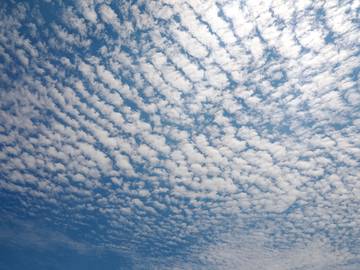
If you are walking, strolling, or even gamboling about with someone who tells you to look up at the “mackerel sky,” they’re not saying (necessarily) that there’s something fishy going on with the weather, but simply pointing out a particular cloud formation. A mackerel sky is one that is covered with rows of altocumulus or cirrocumulus clouds resembling the patterns on a mackerel’s back. The term has been in use since the late 1600s; mackerel, referring to a commercially important food fish of the North Atlantic that is green above with dark blue bars and silvery below, comes (via the Middle English makerel), from Anglo-French.
Icy cirrus and cirrocumulus clouds (commonly known as a mackerel sky) high in the atmosphere are expected to increase as early as Saturday, the first sign of monsoon moisture spreading over California.
—