The Words of the Week - Dec. 12
Dictionary lookups from yuletide, typefaces, and megamergers
An order by Secretary of State Marco Rubio regarding typefaces used by the U.S. State Department led to a rise in lookups for serif and sans serif.
While mostly framed as a matter of clarity and formality in presentation, Mr. Rubio’s directive to all diplomatic posts around the world blamed “radical” diversity, equity, inclusion and accessibility programs for what he said was a misguided and ineffective switch from the serif typeface Times New Roman to sans serif Calibri in official department paperwork.
—Michael Crowley and Hamed Aleaziz, The New York Times, 9 Dec. 2025
Serif refers to any of the short lines stemming from and at an angle to the upper and lower ends of the strokes of a letter. Sans serif describes a letter or a type face with no serifs. Serif probably comes from the Dutch word schreef, meaning “stroke, line.” The preposition sans that forms part of sans serif means “without.”
Antitrust has been in the news lately and seen a corresponding rise in lookups.
Google facing antitrust probe in Europe
—If there are regulatory issues that come into play—and a combination of Netflix and Warner Bros certainly sets off alarms—then antitrust agencies such as the Department of Justice and Federal Trade Commission step into the ring.
—
According to our definition, the adjective antitrust describes that which is “of, relating to, or being legislation against or opposition to trusts or combinations,” and especially “consisting of laws to protect trade and commerce from unlawful restraints and monopolies or unfair business practices.” The relevant sense of trust here is “a combination of firms or corporations that is formed by a legal agreement and reduces or threatens to reduce competition.”
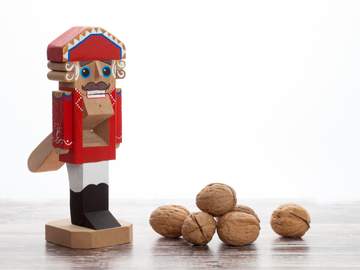
Oh the weather outside is frightful, but the dictionary is so delightful for looking up seasonal holiday words—as evidenced by lookups for nutcracker being higher than usual this week.
The 31-year-old R&B artist and producer [Jordan Barone] ... is stepping into the holiday canon with “Holding On To Christmas,” a smooth, wistful Christmas single shaped by heartbreak and homespun creativity. The live music video, which leans all the way into its vintage holiday aesthetic, premieres today. ... “I was like, I want the nutcrackers, the fire, the fake snow, the tree, all that stuff,” he said. “I wanted it to look like it was Christmas Day.”
—
We define nutcracker as simply “an implement for cracking nuts.” Decorative Christmas nutcrackers often come in the form of wooden soldiers, guards, kings, etc., but the word nutcracker is used for all kinds of tools, gadgets, and gizmos used for puncturing pecans and walloping walnuts.
A ruling by a federal judge in the case of Kilmar Abrego Garcia may be responsible for a rise in lookups for authority.
In her 31-page decision, Judge Xinis said she had little choice but to release Mr. Abrego Garcia, pointing to a remarkable but often overlooked fact about the case: The Trump administration had never obtained a valid final order for his removal from the United States. The lack of a removal order, Judge Xinis said, meant that the government had been holding Mr. Abrego Garcia without legal authority.
—
We define many senses of authority. The relevant sense in this case comes from our legal dictionary: “the power to act that is officially or formally granted (as by statute, corporate bylaw, or court order).”
Unclubbable is a synonym of unsociable meaning “having or showing a disinclination for social activity.” (The club element of the word refers to social clubs.) The word unclubbable dates to the 1760s, a time when lexicographer Samuel Johnson was still riding a wave of fame in the wake of the publication of his 1755 A Dictionary of the English Language. Johnson himself likely coined unclubbable, which does not, to the best of our knowledge, have the literal secondary meaning of “incapable of being hit with a club.”
He was socially inept, unclubbable, even boring.
—