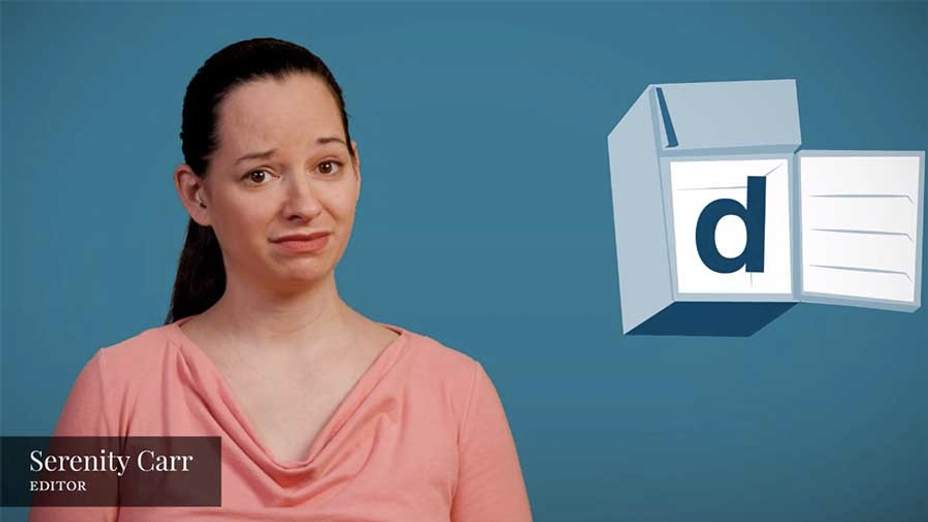
play serenity carr next to an illustration of a refrigerator with the letter d in it

Why is there a 'd' in 'fridge' but not in 'refrigerator'?

Thawing one of the mysteries of English


English sometimes does not follow the path you expect. Like when refrigerator is shortened to fridge. Serenity Carr explains how the latter ended up spelled the way it is.

Transcript

Why is there a D in fridge but not in refrigerator? As a general rule, a G at the end of a word sounds like the G in flag and hog. Anywhere else in a word, it can sound like either gesture or forget. The G in refrigerator follows this rule. If we shortened refrigerator to fridge we're left with F-R-I-G. But wouldn't that rhyme with sprig? The spelling with a D most likely came into use because English speakers wanted it to follow the pattern of other familiar words, like bridge, ridge and smidge.

Up next

play serenity carr next to an illustration of a refrigerator with the letter d in it
Why is there a 'd' in 'fridge' but not in 'refrigerator'?


Thawing one of the mysteries of English

play emily-brewster-with-the-words-effect-affect-on-screen
How to Remember 'Affect' and 'Effect'


A simple way to keep them apart. (Most of the time.)

play sneaked vs snuck video
Sneaked vs. Snuck


How the irregular 'snuck' sneaked into the dictionary

play video ghost words
How a Ghost Word Appeared in the Dictionary


An imaginary word that snuck into the dictionary

play emily brewster and one and the same text graphic
'One in the same' or 'One and the same'?


Is it all the same anyway?

play video websters video of 1864
Webster's Dictionary of 1864


The landmark edition that transformed the way dictionaries are made.

play semantic bleaching text on white background
What Is 'Semantic Bleaching'?


How 'literally' can mean "figuratively"