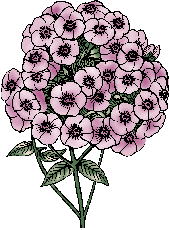
: any of a genus (Phlox of the family Polemoniaceae, the phlox family) of American annual or perennial herbs that have usually pink, purplish, white, or variegated flowers, a salverform corolla with the stamens on its tube, and a 3-valved capsular fruit
Illustration of phlox
Examples of phlox in a Sentence
Recent Examples on the Web
Examples are automatically compiled from online sources to
show current usage.Read More
Opinions expressed in the examples do not represent those of Merriam-Webster or its editors.
Send us feedback.
To combat this issue, trim phlox plants in the fall and carefully dispose of any diseased leaves, either by burning or bagging them for trash disposal to prevent spreading the fungus.—
Lauren Landers,
Better Homes & Gardens,
28 Sep. 2026 Like all new plants, moss phlox should be watered regularly until the ground freezes and mulched in late fall to insulate the roots against the winter cold.—
Nadia Hassani,
The Spruce,
6 Sep. 2026 And you’ll be treated to a lush habitat of native plants, including prickly phlox, chaparral yucca, black sage, hollyleaf cherry and Coulter’s Matilija poppy.—
Jaclyn Cosgrove,
Los Angeles Times,
27 Aug. 2026 One that seems to grow along dry roadsides — and in fields — is annual phlox with blooms of many colors.—
Tom MacCubbin,
The Orlando Sentinel,
18 July 2026 See All Example Sentences for phlox
Word History
Etymology
borrowed from New Latin Phlox, a genus name, going back to Latin phlog-, phlox "a flame-colored flower," borrowed from Greek phlóx, genitive phlogós "flame, flash (of lightning), blaze, radiance, inflammation, a flame-colored flower," o-grade derivative from the stem of phlégein "to burn up, blaze, gleam" — more at phlegm
Note:
The genus name Phlox was introduced by linnaeus (Species plantarum, 1753), who adapted it in Hortus Cliffortianus (Amsterdam, 1737, p. 63) from Theophrastus's name for a plant, identified as the wallflower (Erysimum cheiri) by Liddell and Scott's dictionary and Arthur Hort's translation of Historia plantarum (Theophrastus: Enquiry into Plants, vol. 2 [London/New York, 1916], p. 44).


 Copy Citation