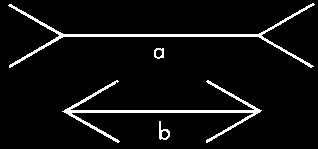
Allusion and illusion may share some portion of their ancestry (both words come in part from the Latin word ludere, meaning “to play”), and sound quite similar, but they are distinct words with very different meanings. An allusion is an indirect reference, whereas an illusion is something that is unreal or incorrect. Each of the nouns has a related verb form: allude “to refer indirectly to,” and illude (not a very common word), which may mean “to delude or deceive” or “to subject to an illusion.”
delusion implies an inability to distinguish between what is real and what only seems to be real, often as the result of a disordered state of mind.
delusions of persecution
illusion implies a false ascribing of reality based on what one sees or imagines.
an illusion of safety
hallucination implies impressions that are the product of disordered senses, as because of mental illness or drugs.
suffered from terrifying hallucinations
mirage in its extended sense applies to an illusory vision, dream, hope, or aim.
claimed a balanced budget is a mirage
Examples of illusion in a Sentence
The video game is designed to give the illusion that you are in control of an airplane.
They used paint to create the illusion of metal.
She says that all progress is just an illusion.
Recent Examples on the Web
Examples are automatically compiled from online sources to
show current usage.Read More
Opinions expressed in the examples do not represent those of Merriam-Webster or its editors.
Send us feedback.
Order is restored to the kingdom through what is known as the Rumpelstiltskin effect, a term used by psychologists to describe the naming of something in order to create an illusion of understanding it.—Literary Hub,
5 Aug. 2026 Her hairstylist, Danielle Priano, certainly leaned into the illusion.—
Marci Robin,
Allure,
5 Aug. 2026 Although those technologies are helpful, the modern workplace risks falling into psychological traps like premature reward and the goal progress illusion.—
James Davis,
Forbes.com,
4 Aug. 2026 As the Liu family struggles to maintain the illusion of unity, Xiaoliu’s body begins to undergo an inexplicable transformation.—
Georg Szalai,
HollywoodReporter,
4 Aug. 2026 See All Example Sentences for illusion
Word History
Etymology
Middle English illusioun "mockery, derision, deception, something that deceives the senses or imagination," borrowed from Anglo-French & Late Latin; Anglo-French illusion, borrowed from Late Latin illūsiōn-, illūsiō, going back to Latin, "ridicule," from illūdere "to make fun of, speak mockingly of, fool, dupe" (from il-il- + lūdere "to play, jest, amuse oneself, trifle with, tease") + -tiōn-, -tiō, suffix of verbal action — more at ludicrous