Noun
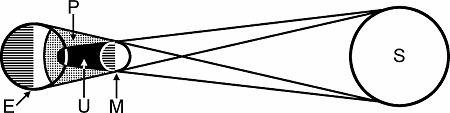
an eclipse of the sun
The popularity of television led to the eclipse of the radio drama.
an artist whose reputation has long been in eclipseVerb
The sun was partially eclipsed by the moon.
Train travel was eclipsed by the growth of commercial airlines.
Recent Examples on the Web
Examples are automatically compiled from online sources to
show current usage.Read More
Opinions expressed in the examples do not represent those of Merriam-Webster or its editors.
Send us feedback.
Noun
Seghers’s Communist affiliations explain the eventual eclipse of her work in the West.—
Alex Ross,
New Yorker,
12 Oct. 2026 Arcos sits very close to the northern limit of the path, which some eclipse chasers seek out specifically for a longer display of Baily’s beads.—
Jamie Carter,
Space.com,
10 Oct. 2026
Verb
In ten countries, interest payments eclipse the entire public investment budget.—
Masood Ahmed,
Fortune,
17 Oct. 2026 But Krasner has long been eclipsed by the shadow of her husband, even after his death in 1956.—
David Morgan,
CBS News,
16 Oct. 2026 See All Example Sentences for eclipse
Word History
Etymology
Noun
borrowed from Middle English eclipse, clips, borrowed from Anglo-French eclyps, eclypse, borrowed from Latin eclīpsis, borrowed from Greek ékleipsis "abandonment, failure, cessation, obscuring of a celestial body by another," from ekleípein "to leave out, abandon, cease, die, be obscured (of a celestial body)" (from ek-ec- + leípein "to leave, quit, be missing") + -sis-sis — more at delinquent entry 2
Verb
Middle English eclypsen, clypsen, derivative of eclipseeclipse entry 1, probably after Medieval Latin eclīpsāre or Middle French esclipser


 Copy Citation