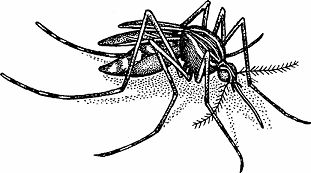
: any of a family (Culicidae) of dipteran flies with females that have a set of slender organs in the proboscis adapted to puncture the skin of animals and to suck their blood and that are in some cases vectors of serious diseases
Examples are automatically compiled from online sources to
show current usage.Read More
Opinions expressed in the examples do not represent those of Merriam-Webster or its editors.
Send us feedback.
Armedangels won the accolades in the outdoors category and was joined by Royal Robbins Salathé Sun Hoodie, which offers chemical-free mosquito protection.—
Arthur Zaczkiewicz,
Footwear News,
22 Oct. 2026 The sun sets, the mosquitoes come out, and Hollywell serves Betty her kibble dinner in a giant glass mixing bowl before sliding a black leather vest over his band tee.—
Nina Corcoran,
Pitchfork,
21 Oct. 2026 The Mescalero Apache traditionally lived on hills above the creeks and wetlands to avoid rising water and mosquitoes, Walsh Padilla said.—
Abe Streep,
ProPublica,
21 Oct. 2026 The biters, smaller than mosquitoes, are known as biting midges or no-see-ums.—
Kris Millgate,
Outdoor Life,
14 Oct. 2026 See All Example Sentences for mosquito
Word History
Etymology
Spanish, diminutive of mosca fly, from Latin musca — more at midge
: any of numerous two-winged flies of which the females have a needlelike structure of the mouth region adapted to puncture the skin and suck the blood of animals
: any of numerous dipteran flies of the family Culicidae that have a rather narrow abdomen, usually a long slender rigid proboscis, and narrow wings with a fringe of scales on the margin and usually on each side of the wing veins, that have in the male broad feathery antennae and mouthparts not fitted for piercing and in the female slender antennae and a set of needlelike organs in the proboscis with which they puncture the skin of animals to suck the blood, that lay their eggs on the surface of stagnant water, that include many species which pass through several generations in the course of a year and hibernate as adults or winter in the egg state, and that include some species which are the only vectors of certain diseases see aedes, anopheles, culex


 Copy Citation