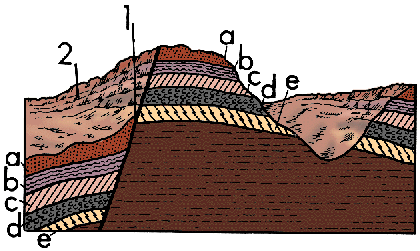
: a fracture in the crust of a planet (such as the earth) or moon accompanied by a displacement of one side of the fracture with respect to the other usually in a direction parallel to the fracture
Frequent earthquakes have occurred along the San Andreas Fault.
fault implies a failure, not necessarily culpable, to reach some standard of perfection in disposition, action, or habit.
a writer of many virtues and few faults
failing suggests a minor shortcoming in character.
being late is a failing of mine
frailty implies a general or chronic proneness to yield to temptation.
human frailties
foible applies to a harmless or endearing weakness or idiosyncrasy.
an eccentric's charming foibles
vice can be a general term for any imperfection or weakness, but it often suggests violation of a moral code or the giving of offense to the moral sensibilities of others.
compulsive gambling was his vice
Examples of fault in a Sentence
Noun
Lack of courage is his worst fault.
If the book has a fault, it's that it's too long.
It's your own fault you missed that bus.
Through no fault of his own, he won't be able to attend the meeting.
She committed too many faults to win the match. Verb
The truck driver was faulted for the accident.
Many have faulted her for not acting sooner.
I can't fault him for trying to protect his family.
Recent Examples on the Web
Examples are automatically compiled from online sources to
show current usage.Read More
Opinions expressed in the examples do not represent those of Merriam-Webster or its editors.
Send us feedback.
Noun
The Yankees’ title drought, tied for the longest since 1923, is the fault of many — players (including Judge) and decision-makers alike.—
Ryan Morik Outkick,
FOXNews.com,
9 Oct. 2026 Facts are faced, faults are noted, death and life are seen and held.—Literary Hub,
9 Oct. 2026
Verb
That contrasts with the FAA, which the NTSB has faulted for failing to implement roughly one-third of the recommendations to that safety regulator.—ABC News,
8 Oct. 2026 The teachers union, United Teachers Los Angeles, in a memo to school board members, presented a counter interpretation and said the state team exaggerated the crisis and was implicitly faulting justified wage increases.—
Howard Blume,
Los Angeles Times,
6 Oct. 2026 See All Example Sentences for fault
Word History
Etymology
Noun and Verb
Middle English faute, falte, from Anglo-French, from Vulgar Latin *fallita, from feminine of fallitus, past participle of Latin fallere to deceive, disappoint
Note:
Sometimes when fault is used in legal contexts it includes negligence, sometimes it is considered synonymous with negligence, and sometimes it is distinguished from negligence. Fault and negligence are the usual bases for liability in the law of torts.
2
: responsibility for an act or omission that causes damage or injury to another


 Copy Citation