7 Words for Old-Timey Vehicles
From dandy horses to boneshakers
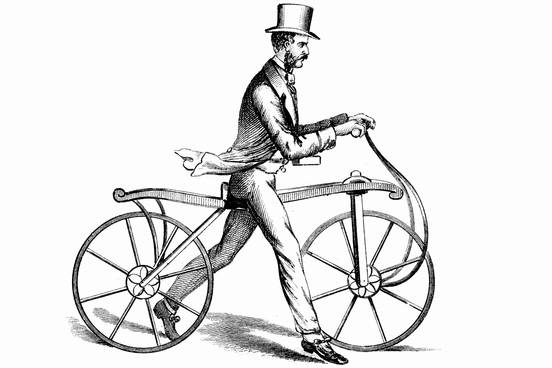
Definition: an early 2-wheeled velocipede propelled by pushing with the feet against the ground
About the Word:
The predecessor of the pedal bicycle was a two-wheeled vehicle that was propelled with the feet while seated. It was patented in 1818 in Germany, and its name, Laufmaschine, (“running machine”) was translated into French as vélocipède (from the Latin roots meaning “swift” and “foot”). In English, this contraption was known as the dandy horse or the hobbyhorse.
When used by expert riders the dandy-horse was capable of no mean speed, and all things considered some very fine performances were accomplished upon it; but the caricaturists fell upon it with great vigour, and the iron tyred wheels and springless perch caused the riders great inconvenience; whilst the mode of driving tended to produce hernia …
—G. Lacy Hillier and W. G. H. Bramson, Amateur Cycling: with Hints on Training, 1893
Definition: a tricycle, a 3-wheeled railroad handcar, or an early bicycle
About the Word:
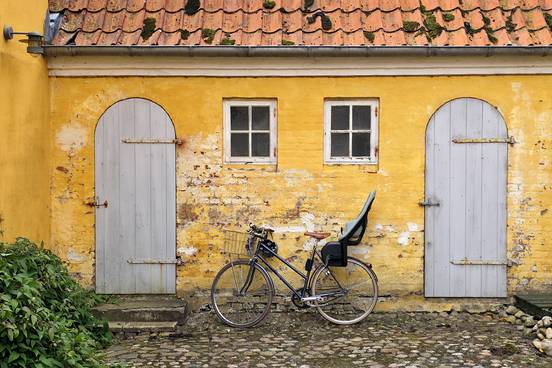
Velocipede was first used in the early 1800s for a dandy horse (the first-known use of both words occurred in the same year), but by the middle of the century expanded to cover pedal-operated vehicles, including tricycles (as in the quote below) and early bicycles.
The grass was brown and frost-bitten, and soon the white snow came and covered it. The stone walks were swept, and when it was not too cold, Willie could ride around the little square, seated on his velocipede.
—
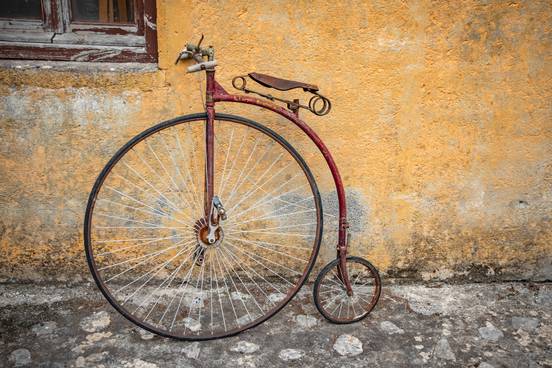
Definition: a bicycle with a large front wheel and a small rear wheel common from about 1870 to 1890
About the Word:
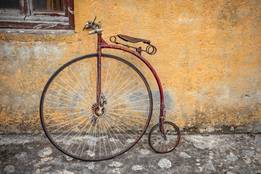
The penny-farthing was invented in France in 1869. The large front wheel allowed for faster speeds, since the power from the pedals at the hub of the wheel was direct drive. A larger wheel meant a greater distance traveled for each pedal turn as well as a smoother ride over bumpy roads. This kind of bicycle was called a hi-wheel or an ordinary after the invention of the chain-driven safety bicycle with equal wheel size.
The term penny-farthing arose in Britain, where a farthing was a small coin worth ¼ of a penny. Put next to each other, the penny resembled the large front wheel and the farthing resembled the small rear wheel. They were dangerous and expensive but popular, and it was because of them that bicycling truly became a sport.
John is quick to stress that he and Douglas ride “ordinaries,” not penny-farthings, which is a derogatory term used in the 1890s by “urchins and guttersnipes.”
—
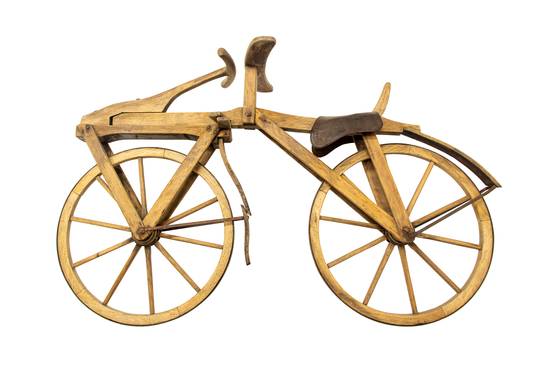
Definition: a dilapidated, uncomfortable, or outmoded vehicle (such as a bicycle of an early model without rubber tires)
About the Word:
Pedal velocipedes were nicknamed boneshakers because they were made with wooden wheels and iron frames. After the introduction of rubber tires, boneshaker became a slang term for an uncomfortable or outmoded bicycle.
It was a fearful thing when one thinks of it. … The smallness of this wheel necessitated the rider sitting far back on the spring in a most ungainly position, and, in the absence of india-rubber tires, the general rattle and the vibration of the iron tires on the road well earned for the machine the soubriquet of “boneshaker.”
—
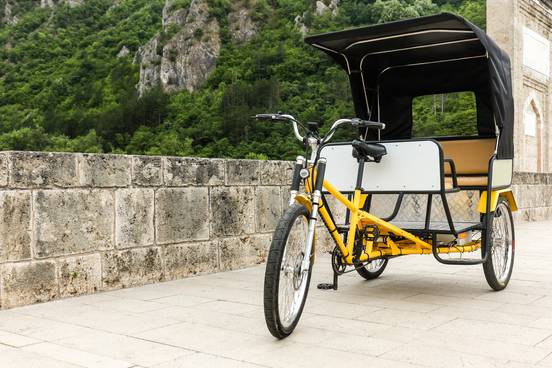
Definition: a tricycle with a 2-seat passenger compartment covered by a usually folding top and a separate seat for a driver who pedals
About the Word:
While penny-farthings and (mercifully) boneshakers are largely of the past, pedicabs are still trucking along, so to speak. The word was first used for the passenger vehicle in the early 20th century, a combination the Latin ped-, meaning “foot,” and the English cab.
… the pedicab company has provided that the driver must bathe regularly, must not eat garlic, must wear a uniform.
—
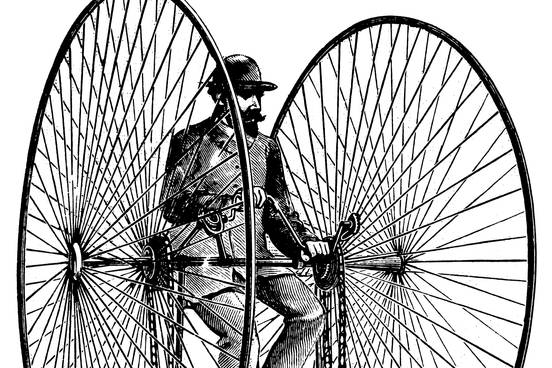
Definition: a velocipede having the two wheels parallel instead of in the same line
About the Word:
The 1800s were truly a hotbed of people-powered vehicle innovation. While the safety bicycle appears to have won the day from our perch here in the 21st century, don’t sleep on the dicycle, literally or figuratively. Although dicycle is currently defined in our Unabridged dictionary as a velocipede with parallel wheels, the word has received (some) modern use for electric motorized scooters with two parallel wheels. While this particular scooter revolution has yet to materialize as promised, hope springs eternal?
In an ‘Otto’ dicycle at rest the mass-centre of the frame and rider is, in its normal position, vertically above the axle of the wheels; the machine is thus in stable equilibrium laterally and in unstable position longitudinally.
—The modern-day city dweller has numerous transportation options, whether it's car, train, bike or even trolley. But finding the ever-elusive parking space, waiting out train delays and competing with rush hour traffic on your average 10-speed bike don't exactly optimize your commute. Some commuters are starting to adopt a more efficient, eco-friendly way to get around their cities—the electric dicycle.
—
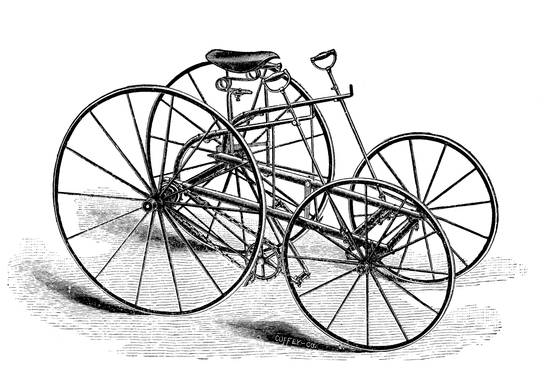
Definition: a motor vehicle with a live two-wheeled axle, a bicycle seat for the driver, and a two-wheeled forecarriage steered by handlebars
About the Word:
While the definition above, and quote below, both refer to a motor vehicle, quadricycle may also refer to a four-wheeled cycle or velocipede for pedal propulsion on roads or railroads. The origin of the word is simple enough; just as bi- in bicycle means “two,” quadri in quadricycle indicates “four.”
The great bicycle manufacturing house of Clement showed a line motor tricycles and a quadricycle which can be transformed into a tricycle at will; as a quadricycle it carries a passenger in front, the person behind having entire charge of the vehicle.
—