The Words of the Week - Sept. 18
Dictionary lookups from optical illusions, AI, and the Pleistocene
A contentious call in a soccer (or football, if you prefer) match between Manchester City and Manchester United led to increased lookups for parallax.
Many observers in the stadium, TV studios and on sofas across the UK and beyond thought Haaland was indeed offside, but that’s because the television images become distorted. This optical illusion, known as a ‘parallax,’ often leads to viewers reaching the wrong conclusion …
—Graham Scott, The New York Times, 14 Sept. 2026
Parallax refers to the apparent displacement, or the difference in apparent direction, of an object as seen from two different points not on a straight line with the object. Its usual context is astronomy, in which it refers especially to the angular difference in direction of a celestial body as measured from two points on the earth's orbit. The word traces back through Middle French to the Greek verb parallassein, meaning “to change.”
Taylor Swift, who has a predilection for dropping quality vocab words hither and yon, was responsible this week for a spike in lookups for saccharide.
Taylor Swift may have only appeared briefly at the 2026 Emmys, but she certainly gave Swifties something to talk about. During a pre-recorded sketch that aired Monday night, the superstar delivered a bizarrely specific line that seemed almost tailor-made for her famously detail-oriented fan base: “Saccharide, Aries, from the vineyard, north or south.”
—
Saccharide refers to a monosaccharide sugar or combination of sugars, and is a synonym of carbohydrate. The combining form sacchar- in saccharide means “sugar,” and traces back through Latin, Greek, and Prakrit to the Sanskrit word śarkarā, used both for gravel and sugar.
Lookups for the adjective anthropic have been high lately, likely due to the word’s appearance in the news as the chosen name of a prominent AI company.
An ex-Anthropic researcher’s resignation over concerns that developers are not acting responsibly has revived the debate over whether increasingly powerful AI models could escape human control.
—
We define anthropic as an adjective used to describe things as “of or relating to human beings or the period of their existence on earth.” Anthropic is a borrowing of the Greek adjective anthrōpikós, “human,” from the noun ánthrōpos, “human being.” While its use in print is currently dominated by references to the AI company, it also appears in lower-case form with the meaning above, especially in scientific publications.
Illustrator and trained geologist Vojta Hybl is captivated by the ties between rocks and humanity. … Hybl’s appealing guide to more than 100 rock types—illustrated by his own hand—stretches from igneous rocks such as gabbro to anthropic rocks such as pottery.
—
Lookups for oligarch spiked this week.
Umar Kremlev, the Russian oligarch at the centre of reports that he helped pay for Donald Trump Jr’s wedding in the Bahamas, has spent the past decade moving through some of Russia’s most politically connected circles.
—
We define two senses of the noun oligarch. The first refers to a member or supporter of an oligarchy, whether that be a group or organization controlled by a privileged few, or a government in which a small group exercises control especially for corrupt and selfish purposes. The second sense, relevant in Russia and other countries that succeeded the Soviet Union, and hence the Guardian story, is defined as “one of a class of individuals who through private acquisition of state assets amassed great wealth that is stored especially in foreign accounts and properties and who typically maintain close links to the highest government circles.” The combining form olig- in oligarchy comes from Greek, and means “few.”
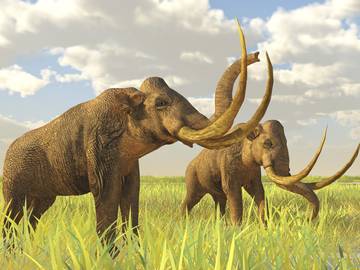
The discovery of an ancient tooth has led to a rise in lookups for mastodon.
The fossilized tooth of a Pacific mastodon, an extinct Ice Age species related to woolly mammoths, was recently found in a California creek. … The tooth, a molar, belonged to an adult mastodon. The species went extinct roughly 11,700 years ago, coinciding with the end of the Ice Age.
—
Mastodon may refer to any of various extinct mammals (genus Mammut synonym Mastodon) of the elephant family existing from the Miocene through the Pleistocene that are distinguished from the related mammoths chiefly by molar teeth with cone-shaped cusps. Mastodons are so named from the nipple-like cusps on the crowns of the molar teeth; the word combines the Greek mastós, “breast, nipple,” with the French -odonte, “having teeth of a specified nature.”
Our Unabridged dictionary defines two senses of fanfaron. The word, which comes from the Spanish fanfarrón, is used as a less common synonym of the similar-sounding fanfare, meaning “a showy outward display.” Its original use, however, is for “an empty boaster,” and synonymous with braggart and swaggerer. If you’ve exhausted the list of such synonyms, which may also include the common blowhard and less common cockalorum, consider fanfaron the next time you have occasion.
… the whole troop proceeded with loud fanfaron and drumbeat to mamma’s door and knocked for admission, and heard her cheery “Come in.”
—… “Listen, number three,” he said, don’t be calling me names I never even heard before.”
“A fanfaron,” Hubert said, “is a hoodlum—a braggart.” And he stopped to find another, lower word.
“Ah, shut up,” Homer said.
—