The Words of the Week - Dec. 19
Dictionary lookups from Hanukkah, Australia, and evolution
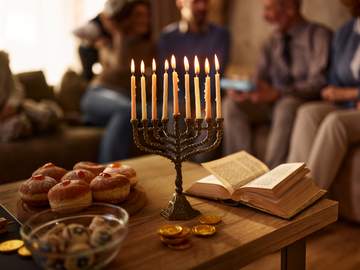
Hanukkah started at sunset on Sunday, December 14, leading to a rise in lookups for the holiday.
The first night of Hanukkah begins on Sunday, Dec. 14, lasting eight days through Dec. 22. The dates are determined based on the Hebrew calendar each year.
—Maria Francis, The Asbury Park (New Jersey) Press, 14 Dec. 2025
Hanukkah is an 8-day Jewish holiday beginning on the 25th of Kislev. It commemorates the rededication of the Temple of Jerusalem after its defilement by Antiochus of Syria, and celebrates the miracle God gave the Jews by keeping the menorah (required in worship) burning for eight days with only one day’s worth of oil. A candle is lit in the menorah each of the eight nights of the holiday to commemorate the miracle; the name for the holiday comes from the Hebrew word ḥănukkāh, meaning “dedication.”
You’ve likely seen the name of this holiday spelled as Hanukkah or Chanukah or Hanukah. Which one is right? All of them (and more). Or none of them. The difficulty arises from the fact that the name for the holiday is Hebrew. As you likely know, Hebrew isn’t written using Latin characters, which means that the Hebrew name for the holiday—חֲנֻכָּה—has to be transliterated. This state of affairs has meant that many English variations on the holiday’s name have proliferated. In fact, the historical Oxford English Dictionary shows 24 variant spellings for Hanukkah. Our evidence shows that the most common of these currently is Hanukkah, though it’s also not uncommon to see Chanukah and Hanukah in print.
The deaths of Rob Reiner and Michele Singer Reiner led to a rise in lookups for inconceivable, a word used prominently in the 1987 film The Princess Bride, which Rob Reiner directed and co-produced.
It would be inconceivable to not include “The Princess Bride” in any consideration of Reiner’s best, as the swashbuckling fantasy romance embodies a sense of playful inventiveness and anything-can-happen ethos.
—
We define two closely related senses of inconceivable: “unbelievable” and “impossible to comprehend.”
News of the mass shooting at Australia’s Bondi Beach led to disarm becoming one of the week’s top lookups.
A bystander is being hailed as a hero after video of him disarming one of the gunmen during the deadly shooting rampage at Australia’s Bondi Beach went viral. Ahmed al Ahmed was identified by Australia’s Home Affairs Minister Tony Burke as the man seen in dramatic footage of a takedown that has been widely circulated on social media.
—
We define the relevant sense of the verb disarm as “to divest of arms.” The arm in both disarm and this definition refers to “a means (such as a weapon) of offense or defense” and is especially used for a firearm. It is etymologically distinct from the arm referring to a limb.
The use of bellicose in a headline by the New York Times caused lookups for that word to spike on Thursday morning.
A Bellicose Trump Points Fingers in Defending His Record on the Economy
—
We define the adjective bellicose as “favoring or inclined to start quarrels or wars,” and trace it back to the Latin word bellum, meaning “war.” Since bellicose, while it can be used figuratively, often describes an attitude that hopes for actual war, the word is generally applied to nations and their leaders. In the 20th century, it was commonly used to describe such figures as Germany’s Kaiser Wilhelm, Italy’s Benito Mussolini, and Japan’s General Tojo, leaders who believed their countries had everything to gain by starting wars. The noun form of bellicose is bellicosity.
A recent study about a species of junco, a songbird, and subsequent articles about the bird, led to more lookups for the word junco than usual.
About two decades ago, the dark-eyed junco, a forest-dwelling sparrow, began to colonize urban Los Angeles. ... The urban juncos ... developed shorter, stubbier beaks, a shift that may have been driven by a change in diet. But when U.C.L.A.’s campus shut down during the pandemic, something remarkable happened: The beaks of juncos born on campus reverted to their wildland shape.
—
The word junco refers to any of a genus of small widely distributed North American finches usually having a pink bill, ashy gray head and back, and conspicuous white lateral tail feathers. It is unrelated to junk, coming instead from the Spanish word junco, meaning “reed.” That junco, after passing through French, also gave English the word jonquil, the name of a type of daffodil.
Our Unabridged dictionary defines the noun gool as an alteration of goal in some dialects. In some parts of the United States—certain locales in New England, for example, or the upper Midwest—gool has been used specifically for an area that is to be reached for safety or as the objective in children’s games, such as tag. It is rare to come across in print, but it sometimes shows up in older texts, such as the stories and books of Henry Augustus Shute (1856-1943), who wrote humorous tales, often in dialect, of small-town New England life.
Aug. 23. brite and fair. tonite me and Pewt and Beany and Fatty Gilman and Fatty Melcher and Billy Swett and Gim Erly and lots of the fellers come up and plaid i spy the bull. one feller lays it and he shets his eyes at the gool and counts fifty and the rest of the fellers go and hide and when he has counted fifty he trys to find the fellers and tag his gool before they do.
—