The Words of the Week - Apr. 18
Dictionary lookups from law, the economy, and the edge of space
Lookups for astronaut were higher than usual this week, as the word has featured prominently in several news stories.
An office in an obscure corner of the federal government that NASA has relied on to safely land astronauts on the moon and robotic probes on Mars is facing pressure to cut its tight-knit team of experts by at least 20 percent, according to two people familiar with the mandate. The thinning of the staff has already started at the Astrogeology Science Center in Flagstaff, Ariz., the people said, the result of an assortment of voluntary resignation offers put forward by the Department of Government Efficiency, led by the billionaire Elon Musk.
—Matthew Phelan, The New York Times, 14 Apr. 2025
At 9:31 a.m. EDT yesterday, Katy Perry, in full hair and makeup wearing a designer cobalt blue bodysuit, was ready to make history. As she boarded flight NS-31 to make an 11-minute roundtrip journey to the edge of outer space, she endeavored to “put the ass in astronaut.”
—
An astronaut is someone whose profession is to travel beyond the earth’s atmosphere. Astronaut is also used more broadly for any person who travels beyond the earth’s atmosphere. The word dates to the early 20th century, combining astro- (“star,” “heavens,” “outer space,” “astronomy”) with naut as in aeronaut, which traces back to the Greek naútēs, meaning “sailor.”
Boycott was also a top lookup this week.
While Trump kept smaller 10% blanket tariffs on countries around the world, he has imposed much higher levies on products from Canada and China, two of the top markets for California’s almonds, pistachios, oranges and other crops. … In recent years, Canada has been the top foreign buyer of California's agricultural exports, including wine, strawberries, lettuce and oranges. The European Union has ranked second, and China has ranked third, providing thriving markets for nuts, dairy products and other commodities. Now, these trade relationships have begun to shift and fray. For example, in addition to Canada's 25% tariffs on many U.S. goods, Canadians have also begun to boycott American products.
—
We define the verb boycott as “to engage in a concerted refusal to have dealings with (a person, a store, an organization, etc.) usually to express disapproval or to force acceptance of certain conditions.” Boycott is an eponymous word, coming from the name of Charles Boycott. A retired British army captain serving as an agent for an absentee landlord in the 1870s, Boycott aroused the ire of many farmers when he tried to evict them for falling behind on rent. His laborers and servants quit, and his crops began to rot. Boycott’s fate was soon well known, and his name became a byword for that particular protest strategy.
For the second week in a row, facilitate has been a top lookup on our site, and often the top lookup, as the word’s definition has become important in a court case.
A sharply-worded section of the [U.S. District Court Judge Paula Xinis’s] order eviscerated the DOJ’s arguments quibbling with the plain English definition of “facilitate” from the Supreme Court ruling as running “contrary to law and logic” (citations omitted): “Notably, to ‘facilitate’ means “to make the occurrence of (something) easier; to render less difficult.” Merriam-Webster defines the term as “to make easier or less difficult: to free from difficulty or impediment.” And the Oxford English Dictionary defines ‘facilitate’ as ‘[t]o assist (a person); to enable or allow (a person) to do something, achieve a particular result, etc., more easily.’ Defendants therefore remain obligated, at a minimum, to take the steps available to them toward aiding, assisting, or making easier Abrego Garcia’s release from custody in El Salvador and resuming his status quo ante. But the record reflects that Defendants have done nothing at all.”
—
Our online dictionary provides a broad definition of facilitate, “to make (something) easier,” in addition to two more specific senses included under that broader umbrella: “to help (something, such as a discussion) run more smoothly and effectively” and “to help bring (something) about.”
Contempt became a top lookup in connection with another lawsuit involving the Trump administration.
A federal judge on Wednesday said he has found probable cause to hold the Trump administration in criminal contempt of court and warned he could seek officials’ prosecution for violating his orders last month to turn around planes carrying deportees to an El Salvador prison.
—
We define the relevant sense of contempt as “willful disobedience to or open disrespect of a court, judge, or legislative body.” We define criminal contempt in our legal dictionary as “contempt consisting of conduct that disrupts or opposes the proceedings or power of the court.”
Recalcitrant was also trending this week.
Mr. Trump invited some of his top officials to Monday’s meeting, much of which was held in front of news cameras. Ms. Bondi and Stephen Miller, who is the architect of Mr. Trump’s immigration agenda, accused Mr. Abrego Garcia of being a member of the MS-13 gang. Mr. Abrego Garcia has never been charged with or convicted of being in a gang. … On Monday evening, more than an hour after the deadline ordered by a judge, the Justice Department submitted its daily update outlining what steps it had taken to return Mr. Abrego Garcia to the United States. It echoed many of the recalcitrant remarks that administration officials had made in the Oval Office.
—
We define the adjective recalcitrant as “obstinately defiant of authority or restraint.” A person may be described as recalcitrant if they are stubbornly refusing to obey rules or orders.
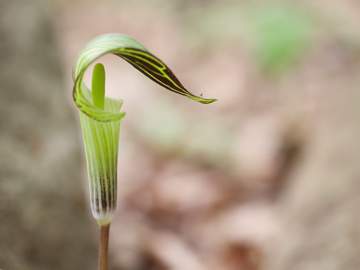
Jack-in-the-pulpit refers to a North American spring-flowering woodland herb of the arum family having an upright club-shaped spadix (the “jack”) arched over by a green and purple spathe (the “pulpit”).
The word jack has been with us since the days of Middle English, when Jacke was used as a familiar term of address for a social inferior. Even then it was also a nickname, at the time for Johan, the Middle English version of “John.” In modern English it is historically a nickname for John but in recent decades it has been commonly used as a full name by itself.
The corollary of the name “Jack” is often “Jill,” and as individual jack-in-the-pulpits can be female, some people refer to the latter as jills-in-the-pulpit. Males typically have a single leaf featuring three leaflets, while female plants sprout two leaves. Take note, however, that from year-to-year, “jacks”-in-the-pulpit can change to “jills” and “jills” to “jacks”:
Of course, not all the flowers are “Jacks;” some of them are “Jills.” And last year’s Jill could very well be this year’s Jack—and vice versa. Jack-in-the-pulpits change sex from year to year based on how much energy a plant contains in its corm, a bulbous underground stem that stores the plant’s carbohydrates.
—