Ten Words Ending with a Silent ‘T’
Spoiler alert: they all come from French

Definition: a friendly, harmonious relationship characterized especially by agreement, mutual understanding, or empathy that makes communication possible or easy
The word rapport (pronounced \ra-POR\) bears a resemblance to a more common English word, report, which is no coincidence: both words come ultimately from the Latin verb portare, meaning “to carry,” and both traveled through French words meaning “to bring back” on their way to English. Report has been in use since the 14th century, when it entered Middle English by way of Anglo-French. Rapport was first used in the mid-15th century as a synonym of report in its “account or statement” meaning, but that meaning had become obsolete by the mid-19th century. It wasn’t until the early 20th century that English speakers borrowed rapport back from French in the meaning of “a friendly, harmonious relationship.” We’re happy to report that rapport has since flourished, and we trust this friendly word will stick around a while.
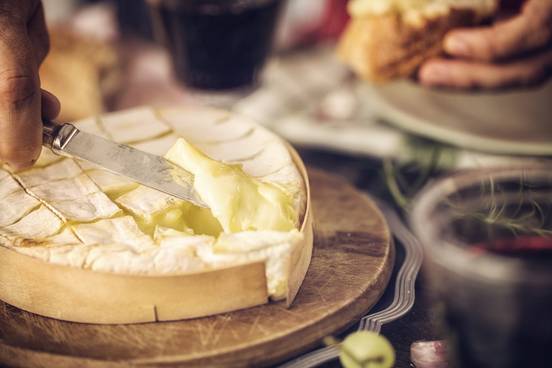
Definition: a soft surface-ripened cheese with a thin grayish-white rind and a yellow interior
Camembert, like the names of a lot of cheeses from cheddar to Brie, comes from its place of origin. Camembert (with its silent ‘t’ just as in “Stephen Colbert”) comes from the name of a village in Normandy famous for the cheese. It is thought that the unpronounced ‘t’ that ends many French words was once long ago pronounced. Essentially, the standard pronunciation changed while the spelling (which carried over in words adopted by English) remained the same.

Definition: a visorless usually woolen cap with a tight headband and a soft full flat top
No cap, there is no French chapeau more iconic than the beret. Beret comes, unsurprisingly, from the French béret. More surprisingly, perhaps, is it that it traces back to berret, a word from Gascon (the Romance speech of Gascony in what is now southwestern France), which came from the Old Occitan (the Occitan language of what is now southern France from about 1100-1500) word for “cap.”
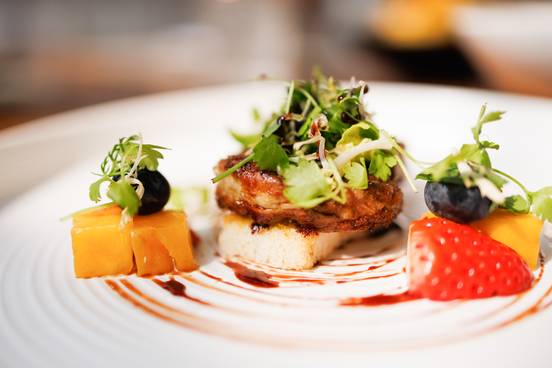
Definition: of, relating to, or being high quality, expensive, or specialty food typically requiring elaborate and expert preparation
Gourmet is defined as “a connoisseur of food and drink.” The word may also function as an adjective, meaning “of, relating to, or being high quality, expensive, or specialty food typically requiring elaborate and expert preparation.” This word is a relative newcomer, not showing up in English until the end of the 18th century as a noun, and the end of the 19th as an adjective.
Gourmet may be traced to the French word grommes, which may mean, among other things, “wine merchant’s assistant.” As seen in its early uses, the word once had a meaning in English that was much closer to its French roots, as it typically referred to one who discriminated in wines, rather than food. Gourmet now shares its meaning with food and drink, and the semantic province of wine words has been largely taken over by such as sommelier (“a wine steward”) and oenophile (“a lover or connoisseur of wine”).

We borrowed argot from French in the early 1800s, although our language already had several words covering its meaning. There was jargon, the Anglo-French ancestor of which meant “twittering of birds”; it had been used for specialized (and often obscure or pretentious) vocabulary since the 1600s. There was also lingo, from the Latin word lingua, meaning “language”; that term had been in use for more than a century. English novelist and lawyer Henry Fielding used it of “court gibberish”—what we tend to call legalese. And speaking of legalese, the suffix -ese is a newer means of indicating arcane vocabulary. One of its very first applications at the turn of the 20th century was for “American ‘golfese.’”

Definition: a small bag containing a perfumed powder or potpourri used to scent clothes and linens
Sachet traces all the way back to Old French, when, as befits its meaning to this day, it represented the diminutive of the word sac, meaning “bag.” Sac came from the Latin saccus, which is the ancestor of many other baggy English words, from sack to satchel.

Definition: flowers picked and fastened together in a bunch
Dry your flowers and stuff them in a little bag and you’ve got a sachet, but pick them fresh and fasten them together and you’ve got a bouquet, with bouquet sharing an end rhyme with its less popular synonym, nosegay. A French borrowing (duh), bouquet traces back to Middle French boucquet (“grove, thicket, bunch of flowers”), going back to Old French (Norman & Picard) bosquet “thicket,” from Old French bos, bois, bosc “grove, forest, wood (the material).”

Definition: a meal set out on a counter or table for ready access and informal service
A buffet could consist of crudités on a cruise ship or cheeseburgers in paradise—the important part is that diners get to make their own plates. Buffet traces back to the Old French, where it could refer to a stool, table, or counter. The verb buffet meaning “to strike repeatedly” (as in “waves buffeting the short”) comes from Anglo-French via Middle English, though its ‘t’ is decidedly pronounced.

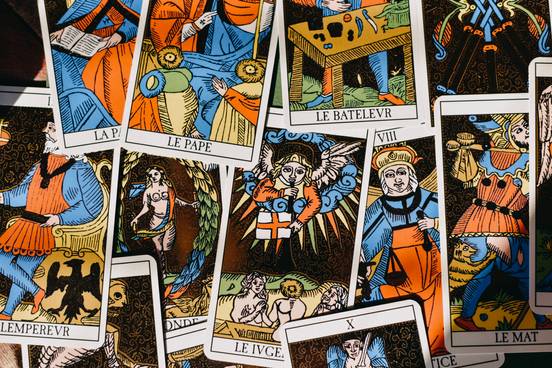
Definition: a set of usually 78 cards including 22 pictorial cards that are used for fortune-telling
You probably guessed that tarot, comes from French (Middle French, to be specific) but did you predict that it came in turn from Italian? Was it in the cards? The Italian word that became the Middle French tarot was the plural noun tarocchi. Tarot decks were invented in Italy in the 1430s by adding to the existing four-suited pack a fifth suit of 21 specially illustrated cards called trionfi (“triumphs”) and an odd card called il matto (“the fool”). (The fool is not the origin of the modern joker, which was invented in the late 19th century as an unsuited jack in the game of euchre.) The trionfi each bore a different allegorical illustration instead of a common suitmark. Such illustrations probably represented characters in medieval reenactments of Roman triumphal processions, similar to floats in a modern festival parade. They were originally unnumbered, so that it was necessary to remember what order they went in. Whether or not trionfi were originally produced independently of standard playing cards, their function, when added to the pack, was to act as a suit superior in power to the other four—a suit of triumphs.