Video
An Abbreviated History of American English Spelling
TRANSCRIPT
Welcome to Ask the Editor, I'm Peter Sokolowski, Editor at Large at Merriam-Webster.
Many people over the years have tried to simplify English spelling. Benjamin Franklin even worked out an entire new phonetic system and George Bernard Shaw funded research into creating a whole new alphabet. But probably the only successful spelling reformer in the history of the English language was Noah Webster, who made the changes that we recognize today as American-English spelling.
Webster was a patriot through and through and he passionately believed that the new nation should have its own language. He said that a national language is a national tie and since America was made up of people from different cultures and classes, it was important to establish that language right away as being distinct from that of the British colonizers.
Webster's first book wasn't a dictionary, but a spelling book. It was a kind of textbook with exercises and readings called the Blue Back Speller and was used for generations to teach reading and writing. A few years later, he published an essay advocating a radical simplification of English spelling.
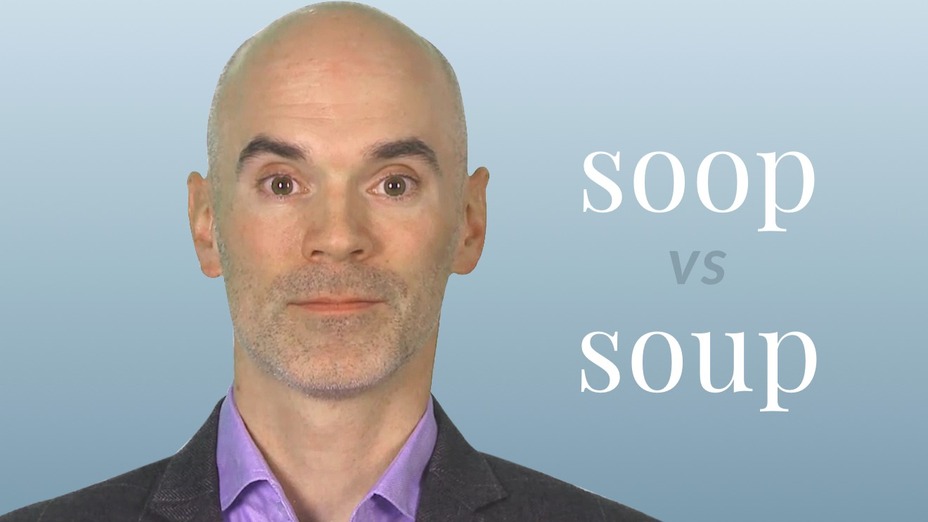
For example, he wanted to spell ache, as in headache, A-K-E, soup with a double o, and to drop the silent E at the end of words like determine.
He would have changed tongue to T-U-N-G, and women to W-I-M-M-E-N.
Those these changes might have been phonetically logical, most of them were just too radical.
However, some of his recommendations caught on.He dropped the U in words like color, humor, and honor, and changed the S to Z in words like civilization and the R-E to E-R in words like center and theater.
Webster believed that the moment right after the Revolution was the time for a declaration of cultural independence and his spelling book and dictionaries marked the beginning of the true recognition of American English.
Watch for more segments of Ask the Editor here at merriam-webster.com.
Cite this Entry
“Soup.” Merriam-Webster.com Thesaurus, Merriam-Webster, https://www.merriam-webster.com/thesaurus/soup. Accessed 19 Nov. 2026.
 Copy Citation