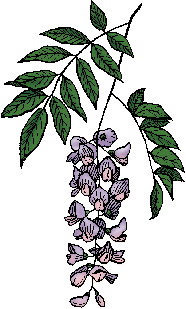
: any of a genus (Wisteria) of mostly woody leguminous vines of China, Japan, and the southeastern U.S. that have pinnately compound leaves and long racemes of showy blue, white, purple, or rose papilionaceous flowers and that include several (such as W. sinensis and W. floribunda) grown as ornamentals
Illustration of wisteria
Examples of wisteria in a Sentence
Recent Examples on the Web
Examples are automatically compiled from online sources to
show current usage.Read More
Opinions expressed in the examples do not represent those of Merriam-Webster or its editors.
Send us feedback.
Flowering vines to prune this season include roses, honeysuckle, moonflower, wisteria, and clematis.—The Spruce,
13 Sep. 2026 There, wisteria blooms on trellises, raspberries ripen on bushes, a cold-plunge pool commands sweeping views of downtown Manhattan—and a chicken coop looms in the corner.—
Ingrid Abramovitch,
Architectural Digest,
10 Sep. 2026 The house, which sat on six acres of land, had eight fireplaces, a gazebo, a volleyball court, and a swimming pool with a diving board, and was surrounded by hyacinths, wisteria, and cherry trees.—
Rachel Aviv,
New Yorker,
17 Aug. 2026 The top clients at Oceanview spend around $150,000 to $200,000 annually to maintain mature trees, pergolas with wisteria, butterfly gardens, and poolside greenery.—
Ben Kesslen,
Curbed,
29 June 2026 See All Example Sentences for wisteria
Word History
Etymology
New Latin Wisteria, from Caspar Wistar †1818 American physician
: any of a genus of mostly woody vines of China, Japan, and the southeastern U.S. that belong to the legume family and have leaves with numerous leaflets and showy blue, white, purple, or rose flowers in long hanging clusters
Etymology
named for Caspar Wistar 1761–1818 American physician


 Copy Citation