: a precious stone of the ancients sometimes held to be the sapphire
b
: a gem zircon or hessonite
2
a
: a plant of the ancients held to be a lily, iris, larkspur, or gladiolus
b
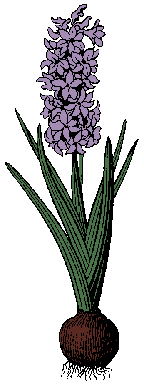
: a bulbous perennial herb (Hyacinthus orientalis) of the asparagus family that is native to the Mediterranean region but is widely grown for its dense spikes of fragrant flowers compare grape hyacinth, water hyacinth
Examples are automatically compiled from online sources to
show current usage.Read More
Opinions expressed in the examples do not represent those of Merriam-Webster or its editors.
Send us feedback.
Tulips, daffodils, crocuses and hyacinths should be planted by mid-October along the Front Range and earlier at higher elevations.—
Pam Rosendal,
Denver Post,
27 Sep. 2026 Neither is as offensive as pungent alliums, but both hyacinths also contain toxic compounds that cause mouth irritation and stomach upset if bitten or ingested.—ABC News,
8 Sep. 2026 Gardeners love to place hyacinths in containers near doorways due to their lovely fragrance.—
Madeline Buiano,
Martha Stewart,
1 Sep. 2026 The house, which sat on six acres of land, had eight fireplaces, a gazebo, a volleyball court, and a swimming pool with a diving board, and was surrounded by hyacinths, wisteria, and cherry trees.—
Rachel Aviv,
New Yorker,
17 Aug. 2026 See All Example Sentences for hyacinth
Word History
Etymology
Latin hyacinthus, a precious stone, a flowering plant, from Greek hyakinthos
: a common garden plant that grows from a bulb, is related to the lilies, and is widely grown for its showy dense spikes of fragrant bell-shaped flowers compare grape hyacinth, water hyacinth


 Copy Citation