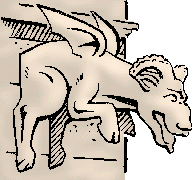
In the 12th century, St. Bernard of Clairvaux reportedly complained about the new sculptures in the cloisters where he lived. "Surely," he is quoted as saying, "if we do not blush for such absurdities we should at least regret what we have spent on them." St. Bernard was apparently provoked by the grotesque figures designed to drain rainwater from buildings. By the 13th century, those figures were being called gargoyles, a name that came to Middle English from the Old French word gargoule. The stone beasts likely earned that name because of the water that gargled out of their throats and mouths; the word gargoule is imitative in origin.
Examples of gargoyle in a Sentence
Recent Examples on the Web
Examples are automatically compiled from online sources to
show current usage.Read More
Opinions expressed in the examples do not represent those of Merriam-Webster or its editors.
Send us feedback.
While retaining an old-school, aristocratic vibe, Adare's fanciful gargoyles, genuinely warm staff, grand and intimate spaces, and super-comfortable rooms make it somewhere uniquely and unabashedly the Ireland of now.—Condé Nast, Condé Nast Traveler, 22 Jan. 2026 Just like Gideon’s has a creepy yet adorable gargoyle named Morsels, Six Ravens will have its own character for fans to connect with.—Megan Dubois, Southern Living, 16 Jan. 2026 This Lego building set recreates Wednesday and Enid's iconic dorm room at Nevermore Academy, full of recognizable features including a spiderweb window that opens, a base with buttons that open secret drawers, and a balcony with 4 gargoyles.—Jacquelyn Smith, Parents, 27 Nov. 2025 Join the crowds taking photos of the ornate building from the piazza, and then ascend to the terrace to marvel at the 135 gargoyles and other carvings up close and take in the city’s skyline.—Laura Itzkowitz, AFAR Media, 3 Oct. 2025 See All Example Sentences for gargoyle
Word History
Etymology
Middle English gargule, gargoyl, from Old French gargoule