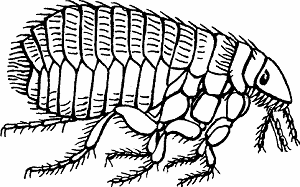
: any of an order (Siphonaptera) of small wingless bloodsucking insects that have a hard laterally compressed body and legs adapted to leaping and that feed on warm-blooded animals
Examples are automatically compiled from online sources to
show current usage.Read More
Opinions expressed in the examples do not represent those of Merriam-Webster or its editors.
Send us feedback.
Health officials are urging residents to take preventive measures by using flea control year-round on their pets and not feeding stray animals.—
Ruben Vives,
Los Angeles Times,
24 Sep. 2026 Before releasing the ferrets, scientists dust prairie dog burrows with insecticide and scatter food pellets laced with fipronil, the same chemical used in flea control among pets.—
Shi En Kim,
AZCentral.com,
21 Sep. 2026 Others say services didn’t fully resolve their pest issues, especially with rodents, mosquitoes, termites or fleas.—
Alora Bopray,
USA Today,
15 Sep. 2026 After a flea flicker led to a pass interference penalty on the Seahawks, the Patriots took over inside the five-yard line.—
Andrew Greif,
NBC news,
10 Sep. 2026 See All Example Sentences for flea
Word History
Etymology
Middle English fle, from Old English flēa; akin to Old High German flōh flea
First Known Use
before the 12th century, in the meaning defined above
Time Traveler
The first known use of flea was
before the 12th century
: any of the order Siphonaptera comprising wingless bloodsucking insects that have a hard laterally compressed body and legs adapted to leaping and that feed on warm-blooded animals see cat flea, chigoe sense 1, dog flea, rat flea, sand flea, sticktight flea


 Copy Citation