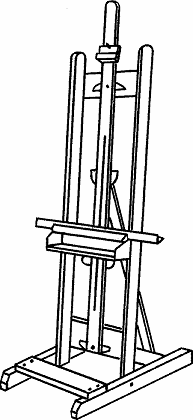
: a frame for supporting something (such as an artist's canvas)
Illustration of easel
Examples of easel in a Sentence
Recent Examples on the Web
Examples are automatically compiled from online sources to
show current usage.Read More
Opinions expressed in the examples do not represent those of Merriam-Webster or its editors.
Send us feedback.
Nearby, there’s a piece taking aim at Philip Guston, whose 1969 painting The Studio, featuring a Klansman at an easel, has been given the AI treatment.—
Alex Greenberger,
ARTnews.com,
23 Sep. 2026 Jewelry sat on and among a sink, chair, cabinet, artist easel, and smaller domestic objects coated in the blue carving wax Vernon uses in the workshop.—
Anna Cafolla,
Vogue,
21 Sep. 2026 The facilitator wrote these down on his giant easel, flipping back and forth between different pages, trying to house them all.—
Esther King,
The Dial,
15 Sep. 2026 For your next craft night, set up the mini canvases on easels, lay out the supplies, turn on a nostalgic Halloween movie, and whip up a few seasonal snacks to munch on for the coziest autumn night.—
Claire Hoppe Norgaard,
Better Homes & Gardens,
4 Sep. 2026 See All Example Sentences for easel
Word History
Etymology
borrowed from Dutch ezel, literally, "donkey," going back to Middle Dutch esel, going back to Germanic *asil- (whence Old Saxon & Old High German esil "donkey," Old English esol, eosol, Gothic asilus), altered from Latin asinus — more at ass entry 1
: a frame for supporting something (as an artist's canvas)
Etymology
from Dutch ezel "a frame to hold an artist's canvas," literally, "donkey"
Word Origin
An easel is a frame for holding up such things as an artist's painting or a chalkboard. In the 17th century the Dutch had become famous throughout Europe for their oil painting. Thus it was their word ezel, which they used to refer to this piece of equipment, that was borrowed into English around that time. This sense of ezel was an extension of the original meaning "donkey," probably because an easel, like a beast of burden, is used to hold things.
Last Updated: - Updated example sentences
Love words? Need even more definitions?
Subscribe to America's largest dictionary and get thousands more definitions and advanced search—ad free!


 Copy Citation