Examples are automatically compiled from online sources to
show current usage.Read More
Opinions expressed in the examples do not represent those of Merriam-Webster or its editors.
Send us feedback.
Noun
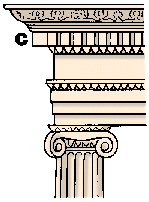
The designers retained many of the hotel’s original architectural elements, including the wrought-iron work behind the front desk, Waterford crystal chandeliers, elegant crown moldings and cornices, and the original King Cole oak bar.—
Irene S. Levine,
Forbes.com,
25 July 2026 Windows cornice the terracotta roofs of Rome, the city’s domes, bell towers and hidden courtyards.—
Sofia Celeste,
Footwear News,
2 July 2026
Verb
Throughout the red-sandstone residence, original detailing remains intact, from wood paneling and fine cornicing to intricate fireplaces.—
Tori Latham,
Robb Report,
26 June 2026 Like its sister properties, punchy decor from Ennismore’s in-house AIME Studios blends the building’s heritage—curled cornicing and sash windows with splashes of color, including deep raspberry red headboards and playful pineapple coat hooks.—
Katharine Sohn,
Architectural Digest,
15 Aug. 2025 See All Example Sentences for cornice
Word History
Etymology
Noun
earlier cornish, borrowed from Middle French corniche, borrowed from Italian cornice "cornice on a column," earlier, "ledge projecting from a rock wall," perhaps going back to Latin cornīc-, cornīx "crow" (assuming a figurative sense "projection, something jutting out" in Vulgar Latin), derivative (with -īc-, -ix, particularizing suffix), from a base *kor-n-, perhaps from the oblique of an n-stem *kor-ōn seen in Greek korṓnē "crow"; the base *kor- "corvid," with different suffixation, seen also in Umbrian curnaco "crow," Greek korak-, kórax "raven," Latin corvus "raven," and, if going back to Indo-European *ḱor-, Russian soróka "magpie," Polish sroka, Serbian & Croatian svrȁka (with secondary -v-), Lithuanian šárka (from Balto-Slavic *ḱor-Hk-), Sanskrit śāri- "kind of bird"
Note:
For an association between something projecting and a corvid cf. the etymology of corbel entry 1. Italian cornice has also been seen as an outcome of Greek korōnid-, korōnís "crook-beaked, curved, curved pen stroke, copestone (in the lexicographer Hesychius)," though phonologically this is implausible. The base *kor-/*ḱor- is ultimately onomatopoeic, perhaps an expansion of *kr-, the initial of other independently derived Indo-European words for corvid birds (cf. crow entry 1, raven entry 1).


 Copy Citation