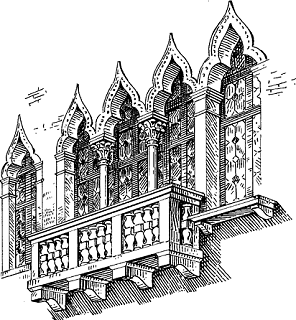
We asked for a hotel room with a balcony.
on summer mornings I often have breakfast out on the balcony
Recent Examples on the Web
Examples are automatically compiled from online sources to
show current usage.Read More
Opinions expressed in the examples do not represent those of Merriam-Webster or its editors.
Send us feedback.
When firefighters arrived, two people were trapped on a second floor balcony.—
Todd Feurer,
CBS News,
21 Oct. 2026 Striking staffers flooded the surrounding streets, lined the balcony of the R Street Parking Garage.—
Graham Womack,
Sacbee.com,
21 Oct. 2026 The spaces are very welcoming and functional, and their original moldings, balconies, woodwork, and structural elements have been restored and integrated with a modern touch.—
Condé Nast,
Condé Nast Traveler,
20 Oct. 2026 The suspect’s mother spoke briefly with CNN off camera from her balcony on Friday.—
Eric Levenson,
CNN Money,
20 Oct. 2026 See All Example Sentences for balcony
Word History
Etymology
borrowed from Italian balcone, earlier also "window (opening), bay window," probably, via the sense "board closing a window, shutter" (as in Upper Italian —15th-century Venetian— balchon "window shutter"), from balc- (borrowed from Langobardic *balkōn "beam," going back to Germanic) + -one, noun suffix, going back to Latin -ō, -ōn-, suffix of nouns denoting persons with a prominent feature — more at balk entry 2
Note:
The Germanic n-stem *balkōn has been adapted to Italo-Romance by means of the suffix -one; parallel adaptations are Italian gherone "gusset, gore," going back, via Langobardic, to Germanic *gaizōn "wedge, flap of a garment" (see gore entry 3); magone (early and regional) "stomach, gizzard," going back to Germanic *magōn "stomach." Balcone in the sense "window" is attested in literary Tuscan since Boccaccio (1341) and persists into the twentieth century most strongly in dialects of the northeast (Veneto, Trentino, Friuli—see Lessico etimologico italiano, Germanismi, vol. 1); attestations in Medieval Latin go back to the twelfth century or earlier. Presumably this meaning is an extension from earlier "shutter," attested in a narrower range of Upper Italian dialects and going back to the fifteenth century in a Venetian text. H. and R. Kahane ("Balcone, the Window," Romance Philology, vol. 30, no. 4 [May, 1977], pp. 565-73) take "board closing a glassless window opening" as the original Langobardic meaning. Note in this regard balcón "trapdoor in the floor of a hayloft" in a dialect of Ticino, with comparable forms and senses in Ladin. A different angle appears to be followed by the Lessico, which points to the meaning "plank floor" (ballatoio), attested as Upper Italian balcon (thirteenth century), Genoese barcon (before 1311), and Piedmontese balcon (thirteenth century). The sense "plank floor" would then have hypothetically been extended to "window sill" (which would have been at or slightly above the level of the floor), and then "window opening." The Lessico records the sense "balcony" in the vernacular in 1312, though Latin forms of the word—in either the sense "balcony" or "opening for a window, bay"— are significantly earlier; according to the Kahanes, who believed balcones was broadcast through western Europe by the Cluniac reforms, they can be dated to the tenth century in England, though this would be earlier than Italian records. The later promulgation of the Italian word to European languages in the quite specific sense "balcony" was a product of the Renaissance and the influence of Italian architecture.


 Copy Citation