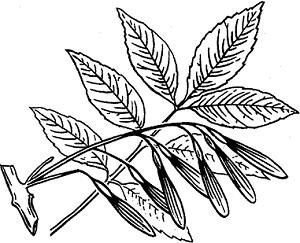
: any of a genus (Fraxinus) of trees of the olive family with pinnate leaves, thin furrowed bark, and gray branchlets
2
: the tough elastic wood of an ash
3
[Old English æsc, name of the corresponding runic letter]: the ligature æ used in Old English and some phonetic alphabets to represent a low front vowel \a\
Noun (2)
a new and more splendid city was built on the ashes of the old
Recent Examples on the Web
Examples are automatically compiled from online sources to
show current usage.Read More
Opinions expressed in the examples do not represent those of Merriam-Webster or its editors.
Send us feedback.
Noun
Those pieces are tiny and brittle, with the consistency of cigar ash, and every swing past the sun leaves more behind.—
Joe Rao,
Space.com,
16 Oct. 2026 No, Rome was not built in a day, but it was built at breathtaking speed, its temples, amphitheaters, and aqueducts rising with the help of a magical blend of volcanic ash and lime.—
Sara Herschander,
Vox,
15 Oct. 2026 In recent years, Canyon has searched for people amid wildfire ash, along steep muddy banks after floods, and beneath homes destroyed by tornadoes.—
Kyle Melnick,
Washington Post,
11 Oct. 2026 The solid ash frame keeps things grounded, with a generously deep seat that gives you room to settle in for a long dinner (or sit crisscrossed, as Arzbaecher prefers).—
Vy Yang,
Architectural Digest,
7 Oct. 2026 See All Example Sentences for ash
Word History
Etymology
Noun (1)
Middle English asshe, from Old English æsc; akin to Old High German ask ash, Latin ornus mountain ash
Noun (2)
Middle English, usually as plural asshen, askes, axen, ashes, going back to Old English axe, asce (feminine weak noun), going back to Germanic *askōn- (whence also Old Saxon asc-, in ascal "ash-colored," Old High German asca, ascha "ash," Old Norse aska) beside apparent *azgō in Gothic azgo "ash," both of uncertain origin
Note:
The older handbooks see the Germanic etymon as a "root extension" of a verbal base *ā̌s- "burn," in current laryngealist terms *h1eh2s-,*h2h̥1s- "make dry through heat" ("[durch Hitze] vertrocknen" in Lexikon der indogermanischen Verben)—see etymology and note at arid. The discrepancy between West and North Germanic ask- (from *azg-?) and Gothic azg- (from *azgh-?) is variously explained. E. Seebold (Etymologisches Wörterbuch der deutschen Sprache, 22. Auflage) regards the velar extension as a suffix of appurtenance, the ashes being in effect "what belongs to the hearth/fire." (Also of relevance would be Armenian azazim "become dry, wither," if from *h2h̥1s-gh- —see H. Martirosyan, Etymologial Dictionary of the Armenian Inherited Lexicon, Brill, 2010 s.v.) Seebold sees the "ash" words with long vowels (Hittite ḫāšš- "ashes, dust," Sanskrit ā́saḥ) as parallel derivations, in this case by the employment of lengthened grade. The inconvenient Gothic word azgo is explained as the outcome of a suffixed verbal derivative *haz-d-ko- (on the verbal derivative see azalea). Departing completely from the root-extension hypotheses, G. Kroonen (Etymological Dictionary of Proto-Germanic, Brill, 2013) sees the Germanic word as a possible compound of Indo-European *h2ed- "dry up" and *dhegwh- "burn."


 Copy Citation