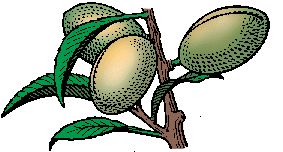
: the drupaceous fruit of a small tree (Prunus dulcis synonym P. amygdalus) of the rose family with flowers and young fruit resembling those of the peach
especially: its ellipsoidal edible kernel used as a nut
This nut is seed of a tree in the rose family, native to Southwest Asia. The tree grows somewhat larger and lives longer than the peach. It is strikingly beautiful when in flower. The nuts are either sweet or bitter. Sweet almonds are the edible type consumed as nuts and used in cooking. The extracted oil of bitter almonds is used to make flavoring extracts for foods and liqueurs. Almonds provide small amounts of protein, iron, calcium, phosphorus, and B vitamins, and are high in fat.
Examples of almond in a Sentence
Recent Examples on the Web
Examples are automatically compiled from online sources to
show current usage.Read More
Opinions expressed in the examples do not represent those of Merriam-Webster or its editors.
Send us feedback.
Don’t skip the dessert—Fouquet’s is famous for its profiteroles topped with Polignac almonds and cognac ganache, as well a signature millefeuille with creamy vanilla custard between paper-thin layers of golden pastry.—Condé Nast, Condé Nast Traveler, 30 Jan. 2026 Almond milk, almond flour, and almond butter are other excellent ways to boost your calcium intake.—Lana Barhum, Verywell Health, 29 Jan. 2026 Many of Cure’s products are imported—German beer, French cheese and Spanish Marcona almonds, which Bodenheimer refuses to substitute.—Irene Adeline Milanez, Bon Appetit Magazine, 28 Jan. 2026 Choose from the Extra-Dirty Martini with its charming little olives (almond, mimosa, and musk scent); the classic Espresso Martini (moka, truffle, and vanilla scent); and Raspberry Champagne (musk, white flowers, and strawberry scent).—Abigail Wilt, Southern Living, 28 Jan. 2026 See All Example Sentences for almond
Word History
Etymology
Middle English almande, from Anglo-French alemande from Late Latin amandula, alteration of Latin amygdala, from Greek amygdalē