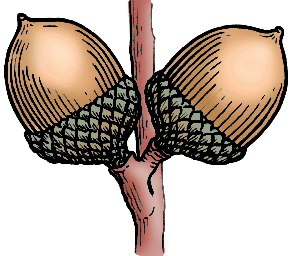
: the nut of the oak usually seated in or surrounded by a hard woody cupule of indurated bracts
Illustration of acorn
Examples of acorn in a Sentence
Recent Examples on the Web
Examples are automatically compiled from online sources to
show current usage.Read More
Opinions expressed in the examples do not represent those of Merriam-Webster or its editors.
Send us feedback.
In New England, the first act was to steal our corn and acorns and beans in 1620 and to torch our villages with men, women, and children inside and to sell the survivors into slavery.—
J. B. MacKinnon,
Harpers Magazine,
29 Sep. 2026 In a kind of treasure hunt, Crouch gathers all the acorns on private lands.—
Jessie Schiewe,
Los Angeles Times,
19 Sep. 2026 Depending on the season, animals could eat the crops, graze grass, or forage for acorns.—
Ingfei Chen,
New Yorker,
18 Sep. 2026 Other autumnal icons include apples, footballs, ghosts, witch hats, and mini acorns and leaves.—Better Homes & Gardens,
16 Sep. 2026 See All Example Sentences for acorn
Word History
Etymology
Middle English akorn, akkorn (partially assimilated to corn "kernel, corn entry 1"), hakerne, accherne, accharne, going back to Old English æcern, going back to Germanic *akrana- (whence also Middle High German ackeran "tree nuts," Old Norse akarn, Gothic akran "fruit, produce"); akin to Old Irish írne "sloe, kernel," Welsh eirin "plums, sloes," aeron "fruits, berries," going back to Celtic *agrinyo-, *agranyo-; perhaps further akin to a Balto-Slavic word with an initial long vowel (Old Church Slavic agoda "fruit," Polish jagoda "berry," Lithuanian úoga)
Note:
Taken to be a derivative of Indo-European *h2eǵros "uncultivated field, pasture" (see acre), though this would seem to exclude the Balto-Slavic etymon, which lacks the suffix, from consideration. It is also not clear if fields, uncultivated or not, are the source of wild tree nuts.
First Known Use
before the 12th century, in the meaning defined above
Time Traveler
The first known use of acorn was
before the 12th century


 Copy Citation