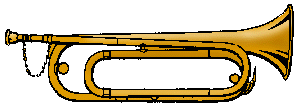
Illustration of bugle


What is the origin of bugle?
In early English, the word bugle meant “wild ox.” The horns of oxen were made into signaling devices for soldiers and hunters, first called bugle horns. Later this was shortened to bugle.
 Literary Hub, 10 June 2026
Community members can join Taps Across America with a live taps bugle call at 3 p.m. May 25 at the flagpole of First Presbyterian Church, 500 Farragut Circle.
—Linda McIntosh, San Diego Union-Tribune, 19 May 2026
Taryn Shorr-McKee, Travel + Leisure, 17 May 2026
Visit Yosemite National Park in the fall for vibrant colors and open access to popular trails like Mist Trail, Great Smoky Mountains National Park in the spring for gorgeous wildflower blooms, or Rocky Mountain National Park in September for golden Aspen tree hikes and bugling elk.
—Jessica Chapel, Condé Nast Traveler, 6 Sep. 2025
See All Example Sentences for bugle
Literary Hub, 10 June 2026
Community members can join Taps Across America with a live taps bugle call at 3 p.m. May 25 at the flagpole of First Presbyterian Church, 500 Farragut Circle.
—Linda McIntosh, San Diego Union-Tribune, 19 May 2026
Taryn Shorr-McKee, Travel + Leisure, 17 May 2026
Visit Yosemite National Park in the fall for vibrant colors and open access to popular trails like Mist Trail, Great Smoky Mountains National Park in the spring for gorgeous wildflower blooms, or Rocky Mountain National Park in September for golden Aspen tree hikes and bugling elk.
—Jessica Chapel, Condé Nast Traveler, 6 Sep. 2025
See All Example Sentences for bugle
“Bugle.” Merriam-Webster.com Dictionary, Merriam-Webster, https://www.merriam-webster.com/dictionary/bugle. Accessed 17 Jun. 2026.
 Copy Citation