Illustration of insect
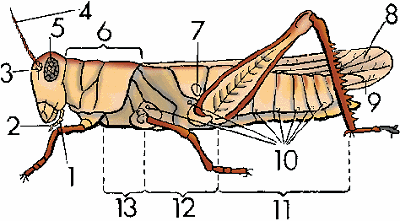
- 1 labial palpus
- 2 maxillary palpus
- 3 simple eye
- 4 antenna
- 5 compound eye
- 6 prothorax
- 7 tympanum
- 8 wing
- 9 ovipositor
- 10 spiracles
- 11 abdomen
- 12 metathorax
- 13 mesothorax

The bodies of insects have segments, or divisions, so they appear to have a series of notches cut into them. This led the Greek philosopher Aristotle to give insects the name entomon “a thing cut into.” Entomon comes from the prefix en- “in,” combined with the verb temnein “to cut.” Later, when the Romans wanted a word for this kind of creature, they did not simply borrow the Greek word. Instead they translated it with the Latin word insectum, from the verb insecare “to cut into.” Insectum was borrowed into English as insect.
 Lauren Landers, The Spruce, 16 June 2026
Pests and Disease Sap-sucking insects like thrips, spider mites, aphids, and whiteflies can stunt plant growth or cause severe flower and leaf drop.
—Mary Marlowe Leverette, Southern Living, 16 June 2026
Pest control experts recommend switching to yellow bug lights, which tend to attract fewer insects than traditional bulbs.
—Tiffani Jackson, Fort Worth Star-Telegram, 16 June 2026
Stinging insects have nested in a wall or underground.
—Sharon Wu, USA Today, 16 June 2026
See All Example Sentences for insect
Lauren Landers, The Spruce, 16 June 2026
Pests and Disease Sap-sucking insects like thrips, spider mites, aphids, and whiteflies can stunt plant growth or cause severe flower and leaf drop.
—Mary Marlowe Leverette, Southern Living, 16 June 2026
Pest control experts recommend switching to yellow bug lights, which tend to attract fewer insects than traditional bulbs.
—Tiffani Jackson, Fort Worth Star-Telegram, 16 June 2026
Stinging insects have nested in a wall or underground.
—Sharon Wu, USA Today, 16 June 2026
See All Example Sentences for insect
“Insect.” Merriam-Webster.com Dictionary, Merriam-Webster, https://www.merriam-webster.com/dictionary/insect. Accessed 18 Jun. 2026.
insect
noun
from Latin insectum "insect," derived from insecare "to cut into," from in- "in" and secare "to cut" — related to dissect, section
 Copy Citation