The Words of the Week - Sept. 4
Dictionary lookups from literature, hydrology, and potent potables
Hydronym became a word of the week following a social media post by Canadian prime minister Mark Carney.
The name Lake Ontario comes from the Wendat word Ontari’io, which, appropriately, means “the lake is beautiful, the lake is big”. … We know that America is changing. Their trading relationships, their foreign policies, their national monuments, their hydronyms.
—@MarkJCarney, X (formerly Twitter), 27 Aug. 2026
Prior to Prime Minister Carney’s post, hydronym (which refers to the name of a body of water such as a lake or river) mostly appeared in print in academic publications focused on subjects including linguistics, cartography, etc. It is not a common enough word (yet) to meet our criteria for entry, but hydronymy (“names of bodies of water”) is entered in our Unabridged dictionary. Hydronym appears to have arisen in the mid-20th century, according to current evidence, and combines hydr- (“water”) and -onym (“word, name”).
An article in the New York Times about ferrets appears to have driven increased lookups for the word ferret.
The ferrets arrived in cages and strollers, cradled in arms and nuzzled on necks. With their humans, they descended on an Ohio exposition center on Saturday to celebrate the finer qualities of one of America’s more divisive pets.
—
We define the relevant sense of the noun ferret as “a domesticated usually albino, brownish, or silver-gray animal (Mustela furo synonym Mustela putorius furo) that is descended from the European polecat.” Ferret may also refer to the black-footed ferret (a rare weasel of western North America) or to “an active and persistent searcher.” Ferret can also be used as a verb meaning “to hunt with ferrets” or “to search about.” The word can be traced back to the Latin word fur, meaning “thief.”
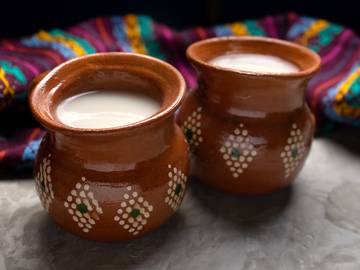
Lookups for pulque were higher than usual this week.
In September 2026, Mexico City will host another edition of the Pulque, Traditional Cuisine, and Mezcal Festival. In fact, it’s the third and final edition of the year, so if you missed the previous ones, this is your chance to enjoy some delicious pulque shots.
—
Pulque refers to a Mexican alcoholic beverage made from the fermented sap of various agaves (such as Agave atrovirens). Cloudy and whitish in appearance, pulque has a sour buttermilk-like flavor and about 6 percent alcohol content. The word, which first appeared in an English text in the late 1600s, comes from Mexican Spanish, possibly from an obsolete Nahuatl word that came from poliuhqui or puliuhqui, meaning “spoiled,” from the fact that the beverage spoils 24 to 36 hours after preparation, if not pasteurized and bottled. The word for the drink itself in Nahuatl is octli.
Afrofuturism was also trending this week.
The Museum of Science hosts a discussion on Afrofuturism and how these reimagined worlds provide important tools for building new realities. The conversation will probe how technologies could serve all people and explore how speculative thinking could be harnessed for social and scientific progress.
—
We define Afrofuturism as “a movement that showcases and reimagines the futures and stories of Black people throughout the African diaspora in a positive light through the use of art, technology, education, literature, music, etc. and that often incorporates science fiction as a central theme.” Afrofuturist (noun) and Afrofuturistic (adjective) are related words. Afrofuturism has its origins in the works of Black authors, musicians, and artists who imagined a future where Black people held agency and were free from the constraints of systemic racism. Writer and cultural critic Mark Dery, who introduced the term in his essay “Black to the Future” (1993) described it as “speculative fiction that treats African-American themes and addresses African-American concerns in the context of twentieth-century technoculture.”
To finify something or someone, according to our Unabridged dictionary, is to make them fine in appearance, to deck them out, to adorn them with finery, perhaps. The word is not used very often these days, but if you want to finify your speech or prose, have at it! Fanny Fern was for sure fond of finagling it into the fabric of her fiction:
Then there were silks, and satins, and gauzes, and embroideries, and worsted jackets, and tippets, and gloves, and shoes fit for Cinderella. … I should be sorry to see you finified up so.
—