The Words of the Week - Oct. 23
Dictionary lookups from law, myth, and Poe
Lookups for lawyer increased in relation to questions about whether it was proper to call a now-former White House press secretary a lawyer.
“I consulted for a very long time many people in the field [asking], ‘Is it OK and acceptable if I label myself lawyer, not attorney at law, not Katie Zacharia Esquire, but lawyer, and provide legal analysis, not legal advice?’ And they said, ‘Absolutely, absolutely across the board. You can call yourself a lawyer,’” Ms. Zacharia said.
—Mary McCue Bell, The Washington Times, 16 Oct. 2026
We define lawyer as “one whose profession is to conduct lawsuits for clients or to advise as to legal rights and obligations in other matters.”
Monday morning saw a spike in lookups for amontillado. It’s unclear why, but the word features prominently in a short story by Edgar Allan Poe, and it is spooky season, after all.
Edgar Allan Poe is perhaps one of the most famous writers of macabre fiction with familiar titles like “The Tell-Tale Heart,” “The Masque of the Red Death,” and “The Fall of the House of Usher.” I haven’t read them all (yet), but I think my favorite is “The Cask of Amontillado.” To summarize, it’s a tale of revenge in which a man tricks his acquaintance into getting sealed inside a vault, using the promise of amontillado wine as the lure into the trap. It’s a pretty simple but chilling tale, as any good horror story should be!
—
We define amontillado as “a medium dry sherry,” with sherry referring to a Spanish fortified wine with a distinctive nutty flavor, or a similar wine produced elsewhere. Amontillado comes from Spanish, where it translates literally to “done in the manner of Montilla,” a town in Andalusia.
A new television series, Yaga, has led to a rise in lookups for Baba Yaga.
What begins as a standard missing persons investigation soon becomes something darker and stranger. Chicken carcasses hang menacingly on doors. Bloody symbols mar crime scenes. Through it all, Rapp hears whispers of Baba Yaga, a legendary witch from Slavic folklore known for living in a house on chicken legs and flying around in a mortar and pestle.
—
We define Baba Yaga, which comes from the Russian Bába-Jagá, as a “female ogre in Slavic folklore who kidnaps and eats usually children.” A guardian of the fountains of the water of life, she lives with two or three sisters (all known as Baba Yaga) in a forest hut that spins continually on birds’ legs. Her fence is topped with human skulls. Baba Yaga can ride through the air—in an iron kettle or in a mortar that she drives with a pestle—creating tempests as she goes. She often accompanies Death on his travels, devouring newly released souls.
Lookups for Shylock were trending this week after President Trump used the word while campaigning for a Senate candidate.
President Trump said that opponents of Senator Roger Marshall had unfairly cast him as “some kind of a Shylock-type guy.” Mr. Trump used the same slur last year at a rally in Iowa.
—
Shylock is the name of the Jewish moneylender and antagonist of Antonio in Shakespeare’s The Merchant of Venice. We label it as offensive for its use as an insulting and contemptuous term for a Jewish person, and for a person who lends money to others at an exploitatively high rate of interest. Although the latter meaning related to moneylending was not uncommon in early 20th century writings about organized crime, today such use is understood to be rooted in ancient anti-Semitic stereotypes.
Trump is not the first member of the White House to face criticism for use of this word; Joseph Biden, as vice-president, was in a similar situation in 2014.
After coming under criticism from the head of a Jewish organization after he used the word "Shylocks" in a speech, Vice President Biden acknowledged making a "poor" word choice.
—
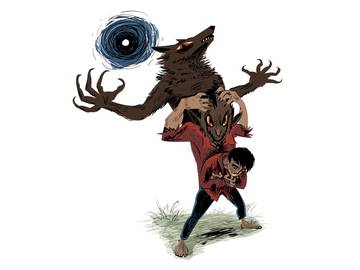
Although English sometimes makes use of other words for howling humanoid beasties, werewolf (“a person transformed temporarily or permanently into a wolf or capable of assuming a wolf’s form”) is the leader of the pack. It’s also an ancient word, tracing all the way back to the Old English werwulf, and before that to a prehistoric predecessor that also left its paw prints on German (Werwolf) and Dutch (weerwolf). Synonyms for werewolf in English include the obscure lycanthrope, which has roots in two Greek words (lykos, meaning “wolf,” and anthrōpos, meaning “human being”), and loup-garou, which comes from Old French. Whichever you use, the lycanthropic creatures these words refer to most often assume wolf form during a full moon—at least in works of fiction. There are no credible studies to date on the behavior of real-life werewolves, as scientists have yet to find the silver bullet that proves they exist.
For the werewolf, for the werewolf / Have sympathy / Because the werewolf, he is someone / Just like you and me / Once I saw him in the moonlight / When the bats were a-flying / All alone I saw the werewolf / And the werewolf was crying …
—