The Words of the Week - Nov. 27
Dictionary lookups from literature, video games, and Thanksgiving
Lookups for Brobdingnagian were high at the tail end of last week and over the weekend, due to the word’s use in a New York Times op-ed.
They’ve also shown that he’s a quasi-state actor, one whose Brobdingnagian wealth owes a lot to American taxpayers and gives him unwarranted power over them.
—Michelle Goldberg, The New York Times, 20 Nov. 2026
We define the adjective Brobdingnagian as “marked by tremendous size.” In Jonathan Swift’s novel Gulliver’s Travels, Brobdingnag is the name of a land that is populated by a race of human giants “as tall as an ordinary spire steeple.” In Gulliver’s first close-up encounter with the giants, he is attempting to get past a stile of which every step is six feet high when a group of field-workers approach with strides ten yards long and reaping hooks as large as six scythes. Their voices he at first mistakes for thunder. Swift’s book fired the imagination of the public and within two years of the 1726 publication of the story, people had begun using Brobdingnagian to refer to anything of unusually large size.
The Thanksgiving holiday led to a rise in lookups for many different words, including cranberry.
Tradition has it that a Thanksgiving turkey dinner is not complete without cranberry sauce.
—
We define the relevant sense of cranberry as “the red acid berry produced by some plants (such as Vaccinium oxycoccos and V. macrocarpon) of the heath family.” The word is a partial translation of the Low German kraanbere, from kraan (“crane”) + bere (“berry”).
Grand theft has been trending due to an enormously popular video game.
“Grand Theft Auto VI” has finally been released, but that doesn’t mean the party is stopping by any means. Fans of the wildly popular video game—following the antics of a Bonnie and Clyde-style couple partially set in Vice City, a bizarro-world Miami—can step away from the console and celebrate …
—
We define grand theft in our legal dictionary as “theft of property or services whose value exceeds a specified amount or of a specified kind of property (as an automobile).” Grand theft is a felony.
News about the U.S. Navy doing away with peacoats has led to a rise in lookups for peacoat.
A naval administrative message issued earlier this month announced that after more than a century, the double-breasted, hip-length wool peacoat that is synonymous with the romance of the sea, would be replaced by the “synthetic black cold weather parka” (among other pieces of outerwear).
—
We define peacoat as “a heavy woolen double-breasted jacket originally worn by sailors.” The word was first used in English in the late 1700s. The pea in peacoat comes from the pea in pea jacket, which debuted earlier in that same century, and was formed by folk etymology from the Dutch pijjekker, from pij, referring to a kind of cloth, + jekker, “jacket.”
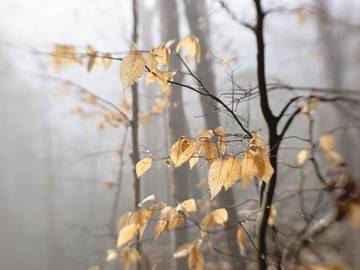
If most of the trees in your neck of the woods have lost their leaves, but some trees are still clinging on to theirs, you may find marcescent worth knowing to help explain this phenomenon. Marcescent is an obscure word that is used of a plant part, such as a leaf, to mean “withering without falling off.” Some species of trees—for example, many oaks and beeches—have marcescent leaves; they hang on throughout the fall and winter unless blown off by wind or pelted by precipitation. If you need the noun form (“the quality or state of being marcescent”) it is marcescence.
Dendrologists often question if marcescent leaves are either helpful, or harmful, when it comes to plant health. When there are a lot of leaves present over the winter with snow or strong winds, or the combination of the two, this could have some negative effects and lead to branch breakage. Plant ecologists have their own theories. Some have suggested that leaves that drop later in the spring will provide a fresh layer of leaf mulch around the tree that helps conserve soil moisture in the spring.
—