The Words of the Week - Nov. 20
Dictionary lookups from transportation, mixology, and entomology
Lookups for FAA were high over the weekend as the nation’s aircraft were grounded by the FAA.
However, the directive instructs departing aircraft to remain grounded until further notice. The listed expiration time does not guarantee that flights will resume by then. The FAA has not provided an estimate for when normal flight operations will return.
—David Shepardson, Reuters, 14 Nov. 2026
We enter FAA as an abbreviation for “Federal Aviation Administration.” The FAA is an agency of the U.S. federal government that is responsible for ensuring the safety and efficiency of civil aviation in the United States and in surrounding international waters. Created as the independent Federal Aviation Agency in 1958, it was incorporated into the newly established Department of Transportation as the Federal Aviation Administration (FAA) in 1967.
Lookups for measles were high this week.
U.S. Loses Its Measles Elimination Status, a Historic Setback for American Health
—
We define measles as “an acute contagious disease that is caused by a paramyxovirus (Morbillivirus hominis) and is marked especially by an eruption of distinct red circular spots.” The word comes from the Middle English meseles, plural of mesel, which refers to both the disease itself and a spot characteristic of measles.
An unusual explosion in California led to a sudden surge in lookups for geyser.
Los Angeles County health officials are ordering the operators of the troubled Chiquita Canyon Landfill in Castaic, California, to provide hotel accommodations and other emergency assistance to nearby residents after a violent eruption sent a towering geyser of decomposing garbage and methane gas into the air Monday afternoon.
—
We define geyser as “a spring that throws forth intermittent jets of heated water and steam.” The use above, concerning not heated water and steam but decomposing garbage, represents a figurative extension of this geyser along the lines of “sudden rushing or upwelling of matter.” This jibes with the word’s origin. Geyser entered English in the late 18th century as an alteration of the Icelandic Geysir, referring to a hot spring in Iceland, which in turn comes from the verb geysa, meaning “to rush forth.”
Lookups for Overton window were high, probably influenced by plays on words involving the name of a now-former nominee to lead the FDA, though the term has seen a sharp spike in usage over the past two years.
Overton window slams shut: White House withdraws Heidi Overton’s nomination to lead FDA
—“The Overton window is opening, and we’re finally seeing politicians willing to imagine something bigger,” she [Reshma Saujani] said. “We shouldn’t be begging for scraps or settling for incremental improvements. Let’s make childcare free. Let’s have some imagination again.”
—
Overton window, which is usually preceded by the, refers to the range of ideas or policies relating to politics or society that are considered moderate enough at a given time to be widely regarded as acceptable or possible to consider. The term comes from the name of Joseph P. Overton, an American political scientist who proposed the concept.
Priapic was trending this week, perhaps due to its use in an article related to a high-profile scandal in the tech world.
A company spokesperson said: “Jensen’s interactions with Ms Huang are not unusual or unexpected.” Isn’t that the truth? Jeff Bezos, Bill Gates, Eric Schmidt, Elon Musk, to name a few, have similar stories. Priapic derives from the original geek.
—
In the quote above, Harding is making a joke playing on the similarity of “geek” (in reference to tech entrepreneurs) and “Greek,” as indeed the word priapic hails from that language (via Latin priapus, meaning “lecher”). In ancient Greek religion, Priapus was a god of animal and vegetable fertility represented in a caricature of the human form, grotesquely misshapen, with an enormous phallus. His father was Dionysus, the wine god, while his mother was either a local nymph or Aphrodite, the goddess of love. Priapic can either mean “phallic” or “relating to or preoccupied with virility or male sexual excitement.”
With speculation over what actor would play the next James Bond (it’s Robert Pattinson), vodka martini rose in lookups.
The 007 finalists share a look, but cinema’s favourite spy might still surprise us. Picture a man, seated at a poker table, wearing a white tuxedo jacket with a red carnation tucked in the lapel. He turns to you with a twinkle in his eye and asks for a vodka martini—shaken, not stirred.
—
The classic martini is made with gin and vermouth. In the films, James Bond usually orders a “vodka martini” that is shaken, not stirred—words that are among the most famous lines in cinema. Ian Fleming actually gives the recipe, in Bond’s voice, for his version of the drink in the novel Casino Royale:
“Three measures of Gordon’s, one of vodka, half a measure of Kina Lillet. Shake it very well until it’s ice-cold, then add a large thin slice of lemon-peel. Got it?”
—
Bond later notes that “This drink’s my own invention. I’m going to patent it when I can think of a good name.”
Ideas about the origin of the name of the drink itself are a bit shaky (or stirred), but it is probably an alteration of Martinez, used for another cocktail.
Note that Bond’s martini still is mostly made of gin (Gordon’s is a venerable British brand of gin), with some vodka added. A martini made with vodka entirely displacing the gin is a variation of the classic formula, usually called a “vodka martini.”
Over the years, some have pointed out that “shaken, not stirred” results in chipped and melting ice in the glass, thereby diluting the potency of the drink, which may be the result intended by the confident superspy.
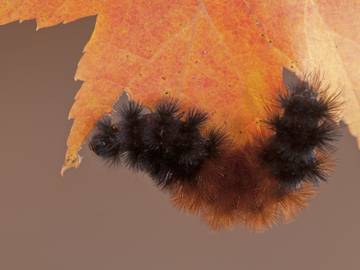
How severe is the coming winter going to be? Ask a woubit! Now, before you call up your local television station and ask to speak to the meteorologist, woubit does not refer to such a human expert in weather and weather forecasting. Rather, woubit is a word in some British dialects for a hairy caterpillar, and especially for a woolly bear. Woolly bear in turn has been used for many different large very hairy moth caterpillars, but especially for a tiger moth caterpillar. One such fuzzy critter, known as the banded woolly bear, is brown in the middle and black at both ends. The width of the black bands is purported to predict the severity of the coming winter: the narrower the bands, the milder the weather will be.
You can learn a passel of new words from Katz’s deliberately hayseed writing style—provided you can find a dictionary that will tell you about spadgers, woubits, rumpscuttle and shinhopples.
—
If you’re curious about what spadgers, rumpscuttle, and shinhoppers are, the first is easy. Spadger is a British term for the house sparrow as well as slang for a small boy.
I was also tormented the day a sparrowhawk took one of the little tweety spadgers.
—A woman in Blackpool called to her little son who was playing in the street; “Come in to your tea, you little spadger.”
—
The other two terms are more obscure, and undefined in our dictionaries, but there is some evidence that shinhopple is a regional term for hobblebush, a white-flowered shrubby viburnum of eastern North America having serrate rounded leaves and red berries.
Off she went through the woods with Duyvelscar running alongside, slipping behind the shinhopples, darting out into the spots of sunshine.
—
Rumpscuttle is also tricky, and it’s unclear what sense of the word was used by Katz in his book of Ohio folklore. Most evidence points to the word at least originating as a synonym of tomboy, but it is possible that it has expanded in use in some corners of the world (Ohio, perhaps!) to refer to some kind of animal.
Moll Cutpurse, whose real name was Mary Frith, a shoemaker’s daughter, born probably in 1584, is described by her biographer as in her girlhood a “very … rumpscuttle” who “delighted and sported only in boy’s plays and costume.”
—