The Words of the Week - Mar. 6
Dictionary lookups from Iran, Florida, and college basketball
The death of Iran’s supreme leader Ayatollah Ali Khamenei in U.S. and Israeli military strikes led to an increase in lookups for ayatollah.
Ayatollah Khamenei dead: Iranian state media confirms Supreme Leader has died
—(headline), The Mirror (UK), 1 Mar. 2026
… after Ayatollah Khomeini’s death in 1989, he [Khamenei] emerged as a consensus candidate. To address the legal requirements, he was designated an ayatollah overnight, and the Constitution was changed to remove the mandate that the supreme leader attain the highest rank in the Shiite hierarchy.
—
We define ayatollah as “a religious leader among Shiite Muslims.” It is used as a title of respect especially for one who is not an imam. Ayatollah comes from the Persian word āyatollāh, which translates literally to “sign of God,” from the Arabic āyatallāh, which combines āya “sign, miracle” and allāh, “God.”
Lookups for war have risen this week amidst disagreements about what to call the United States’ involvement and actions in Iran.
This isn’t a war. We haven’t declared war.
—The Associated Press is referring to fighting between Iran and the United States and Israel as the “Iran war.” The updated description reflects the scope and intensity of the conflict, which has been centered on Iran, even as other parties are drawn in.
—
We define the relevant sense of war as “a state of usually open and declared armed hostile conflict between states or nations.” Two closely related senses are “a period of such armed conflict” and “a state of actual armed hostilities regardless of a formal declaration of war,” also known as a “state of war.” The word war traces back to the Middle English werre, which in turn comes from the Anglo-French werre, guerre, which is of Germanic origin and shares an older ancestor with the Old High German verb werran, meaning “to confuse.”
The rescue of a Florida man drove more lookups than usual for borrow pit.
A Florida man who had been missing since Valentine’s Day was found over a week later trapped in mud up to his shoulders, authorities said. … Vulcan employees, meanwhile, had not stopped looking for signs of Giddens when one spotted him during the early evening of 25 February in shoulder-deep mud by what is known as a borrow pit, the Putnam sheriff’s office said.
—
Borrow pit refers to an excavated area where material has been dug for use as fill at another location.
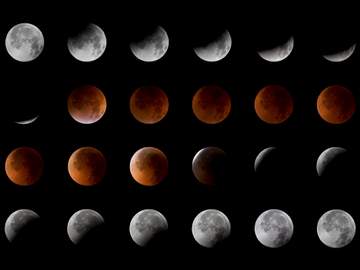
Blood moon was a top lookup this week, for perhaps unsurprising reasons.
The moon will take on a peculiar, coppery red hue during a total lunar eclipse early this week. This “blood moon” always accompanies total lunar eclipses, and in the Bay Area, it will be reddest from 3:04 a.m. to 4:03 a.m Tuesday morning.
—
We define blood moon as “a full moon that coincides with a full lunar eclipse and that has an unusually reddish appearance.” The red color of a blood moon is caused by the diffusion of the sun’s light into the shadow cast by the Earth. Fans of the Legend of Zelda video game franchise will be relieved to know that an actual blood moon does not in fact resurrect fallen monsters.
Our entry for Spartan spiked on Sunday night, possibly because of a win by the Michigan State basketball team.
... the sophomore recorded career highs with 18 points on six made 3-pointers off the bench to help lead the No. 13 Spartans (24-5, 14-4 Big Ten) to a 77-64 win at Indiana on Sunday.
—
When used as a noun, Spartan can refer to a native or inhabitant of the ancient city of Sparta, or to a person of great courage and self-discipline. The latter use comes from Sparta’s reputation for the severe and highly disciplined way of life it enforced among its citizens, so as to keep them ready for war at any time.
In the second edition of our Unabridged dictionary, one can find the word winklehawk which, somewhat surprisingly refers not to a raptor but to “a rectangular rent in cloth.” If you’ve ever ripped your pants in such a way that a little flap opens in them like a door, congrats (and apologies), you had yourself a winklehawk. The word, not much in use these days, comes from the Dutch winkel-haak, meaning “a carpenter’s square.”
When you tear your trousers on a sharp point, is the first word you instinctively apply to the rectangular rent, trappatch, barndoor, or weewary, as says the New Englander, or is it winklehawk or nicklehawk, as New Yorkers say?
—