The Words of the Week - Aug. 14
Dictionary lookups from the earth, the sky, and the atmosphere
The Perseid meteor shower caused many related entries to experience a bump in lookups, including meteor shower.
The Perseids, a celestial display that’s often thought of each year as the ultimate meteor shower, is approaching its prime observational window this week, scientists said. The spectacle may bring roughly 50 to 100 meteors visible per hour across the Long Island sky, with peak views Wednesday overnight into Thursday, according to NASA.
—Tiffany Cusaac-Smith, Newsday (Long Island, New York), 10 Aug. 2026
We define meteor shower as “a large number of meteors seen in a short time.” The term was first used to describe this phenomenon in the mid-19th century.
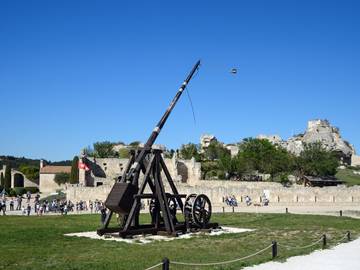
The skeletal remains of a man who died in the 14th century led to a rise in lookups for trebuchet.
Known to archaeologists as Skeleton 150, the man was killed more than 700 years ago by a massive blow that shattered his skeleton in dozens of places before pinning him to the ground. In a presentation at the biannual European meeting of the Paleopathology Association in Berlin last week, University of Bradford bioarchaeologist Jo Buckberry called the skeleton the first confirmed evidence of trebuchet trauma in the archaeological record.
—
We define trebuchet as “a medieval military engine for hurling heavy missiles (such as rocks).” The word comes, via Middle English, from the Anglo-French trebuchet.
Typhoon received higher-than-usual lookups this week, as it often does around this time of year when typhoons regularly occur.
More than a million people were moved to safety across eastern China by Sunday evening as powerful Typhoon Dolphin made landfall amid fears torrential rain would cause flooding and landslides.
—
We define typhoon as “a hurricane occurring especially in the region of the Philippines or the East and South China seas.” Typhoon is an alteration (influenced by the Chinese spoken in Guangdong) of the earlier word touffon, which in turn comes from the Arabic word for hurricane, ṭūfān, and ultimately from the Greek typhōn, meaning “violent storm.”
A strong earthquake in Colombia led to a rise in lookups for epicenter.
A powerful 7.4-magnitude earthquake struck western Colombia on Monday, shaking the South American nation and neighboring Ecuador and prompting people to evacuate homes and buildings. The epicenter was in San Jose Del Palmar, a municipality in the Choco region about 250 miles (400 kilometers) west of Colombia’s capital, Bogota, the U.S. Geological Survey and Colombia’s counterpart reported.
—
Epicenter refers to the part of the earth’s surface directly above the focus of an earthquake (the meaning of epi- in epicenter is “over”). Epicenter can also refer to the centers of things that may seem in their own way as powerful—though not as destructive—as earthquakes. Hollywood, for example, might be said to lie at the epicenter of the entertainment world.
Cuspidor entered English in the early 18th century via the Portuguese word cuspidouro, meaning “place for spitting.” The Portuguese word, unsurprisingly, has its origins in Latin: the word conspuere comes from the prefix com- and spuere, meaning “to spit.” (Spuere also shares an ancestor with the English word spew.) This is all well and good of course, but you may be wondering, why is cuspidor worth knowing? Perhaps you know someone with overactive salivary glands who is prone to hawking (or hocking) loogies and whatnot, and let’s say they are loath to heed your appeals to carry around a spittoon for the collecting of such untidy business. Well, calling a spittoon a cuspidor could make it just fancy enough to convince them.
Spittoon? Unappealing. Déclassé.
Cuspidor? Ooh la la! De rigueur!
Bloom laughed, and directed a stream of tobacco juice into a convenient cuspidor.
—