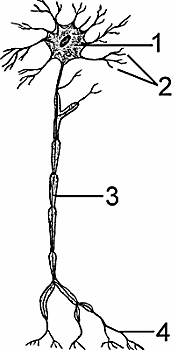
: a grayish or reddish granular cell that is the fundamental functional unit of nervous tissue transmitting and receiving nerve impulses and having cytoplasmic processes which are highly differentiated frequently as multiple dendrites or usually as solitary axons which conduct impulses to and away from the cell body: nerve cellsense 1
Examples are automatically compiled from online sources to
show current usage.Read More
Opinions expressed in the examples do not represent those of Merriam-Webster or its editors.
Send us feedback.
An implant would still have to record enough usable signals to identify the relevant neurons.—
Atharva Gosavi,
Interesting Engineering,
20 Nov. 2026 In healthy neurons, tau helps stabilize the internal scaffolding that supports the cell.—New Atlas,
19 Nov. 2026 Even more extraordinary, that same region—in fact, the exact same neurons—also activated while people listened to speech.—
Allison Parshall,
Scientific American,
19 Nov. 2026 The new clue involves a protein called tau that normally supports neurons but becomes abnormal in Alzheimer’s, tangling inside those nerve cells.—ABC News,
13 Nov. 2026 See All Example Sentences for neuron
Word History
Etymology
borrowed from German Neuron, borrowed from Greek neûron "sinew, tendon, nerve" — more at nerve entry 1
Note:
Term introduced by the German anatomist Heinrich Wilhelm Waldeyer (Heinrich Wilhelm Gottfried von Waldeyer-Hartz, 1836-1921) in "Ueber einige neuere Forschungen im Gebiete der Anatomie der Centralnervensystems," Berliner klinische Wochenschrift, 28. Jahrgang, no. 28, July 13, 1891, p. 691: "Somit besteht ein Nervenelement (eine 'Nerveneinheit' oder 'Neuron', wie ich es zu nennen vorschlagen möchte), den genannten Forschungsergebnissen … zufolge, aus nachstehenden Stücken: a) einer Nervenzelle, b) dem Nervenfortsatze, c) dessen Collateralen und d) dem Endbäumchen." — "Therefore, in accordance with the cited research results, a nerve element (a 'nerve unit' or 'neuron,' as I would like to suggest as a name), consists of the following parts: a) a nerve cell, b) the nerve process [= axon], c) its collaterals and d) the end tree [= axon terminals]." Waldeyer apparently intended -on to be taken as a suffix, indicating a unit, rather than the Greek neuter singular inflectional ending, as he utilized Neuronen as the plural in the same article. Cf. French neurone and the English variant neurone.
: one of the cells that constitute nervous tissue, that have the property of transmitting and receiving nerve impulses, and that are composed of somewhat reddish or grayish protoplasm with a large nucleus containing a conspicuous nucleolus, irregular cytoplasmic granules, and cytoplasmic processes which are highly differentiated frequently as multiple dendrites or usually as solitary axons and which conduct impulses toward and away from the cell body: nerve cellsense 1


 Copy Citation