The volcano last erupted 25 years ago.
after months of tension the roommates' living situation was a volcano
Recent Examples on the Web
Examples are automatically compiled from online sources to
show current usage.Read More
Opinions expressed in the examples do not represent those of Merriam-Webster or its editors.
Send us feedback.
An important hazard is also associated with the glaciers on the steep-sided volcanoes of the Cascade Range, which stretches from California to Washington.—
Andrew Fountain,
The Conversation,
12 Oct. 2026 Ride Kohala and Waimea Kohala, the oldest volcano on the Island of Hawai‘i, rises above Waimea, home to Parker Ranch, one of the country’s largest cattle ranches.—
Kevin Jackson,
Travel + Leisure,
9 Oct. 2026 His ceramic cups sit in saucers that are more like volcano cones, geologic.—
Robert Sullivan,
Vogue,
8 Oct. 2026 Hibachi chefs erected onion volcanoes and squirted sake into the mouths of guests.—
Aidan McLaughlin,
Vanity Fair,
8 Oct. 2026 See All Example Sentences for volcano
Word History
Etymology
Italian or Spanish; Italian vulcano, from Spanish volcán, ultimately from Latin Volcanus Vulcan
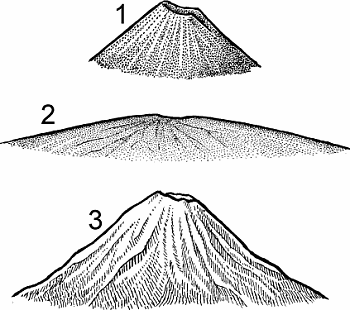
: a vent in the earth's crust from which melted or hot rock and steam come out
also: a hill or mountain composed entirely or in part of the material thrown out
Etymology
from Italian or Spanish; Italian vulcano "volcano," from Spanish vulcán, from Latin Volcanus, Vulcanus "Vulcan (Roman god of fire)"
Word Origin
The ancient Greeks and Romans had many gods and goddesses. Each of these deities was in charge of a special kind of work or an aspect of nature. Many of the happenings in nature were explained in myth as the actions of one or more of these gods or goddesses. The Roman god of fire was known as Vulcanus in Latin (Vulcan in English). He was thought to live inside Mount Etna, a volcano on the island of Sicily. Vulcan was a giant who worked as a blacksmith, forging the thunderbolts for Jupiter, king of the gods. The smoke and occasional fiery rocks and lava that came from Mount Etna were thought to be from Vulcan's forge. That is how his name came to be applied to a mountain that sometimes spews forth fire and smoke.


 Copy Citation