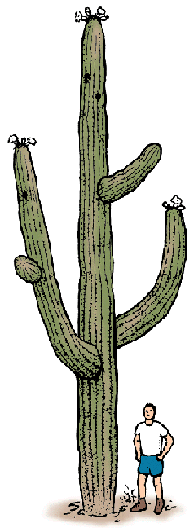
: a tall columnar usually sparsely branched cactus (Carnegiea gigantea) of dry areas of the southwestern U.S. and Mexico that bears white flowers and a scaly reddish edible fruit and that may attain a height of up to 50 feet (16 meters)
called alsogiant cactus
Illustration of saguaro
Did you know?
Venture into the Arizonan desert on a May or June morning and you may see the saguaro in bloom. For many of our readers (such as those living in Arizona and southeastern California), this sight - and the word saguaro - won't be anything new. Or perhaps you know this emblem of all things Southwestern simply as the "giant cactus." The word saguaro originated in Ópata, a language spoken by peoples of the Sonoran Desert region of Mexico. It came into English by way of the Spanish spoken by the Mexican settlers of the American West. The very saguaros we see today may well have been around when the word was first noted, some 150 years ago - this amazing cactus can live for up to 200 years.
Examples of saguaro in a Sentence
Recent Examples on the Web
Examples are automatically compiled from online sources to
show current usage.Read More
Opinions expressed in the examples do not represent those of Merriam-Webster or its editors.
Send us feedback.
The land around Hassayampa Ranch, 50 miles west of Phoenix, is dotted with saguaro cacti and home to coyotes, jackrabbits, and rattlesnakes.—Sharon Goldman, Fortune, 27 Dec. 2025 The park is most famous for its saguaro cacti, the largest in the country, which can grow up to 50 feet tall.—Owen Clarke, Outside, 15 Dec. 2025 The one-mile loop is located in the East District and features educational signs informing visitors about the area’s history and its flora, an old homestead foundation, and a saguaro grove.—Lydia Mansel, Travel + Leisure, 3 Dec. 2025 The mural is inspired by Mexican artist Jose Guadalupe Posada and includes saguaro cactus iconic to Northern Mexico's landscape.—Alec Johnson, jsonline.com, 19 Nov. 2025 See All Example Sentences for saguaro
Word History
Etymology
Mexican Spanish, probably from Ópata (Uto-Aztecan language of Sonora, Mexico)
: a cactus of desert regions of the southwestern U.S. and Mexico that has a spiny branched trunk, bears white flowers and edible reddish fruit, and may reach a height of up to 50 feet (16 meters)