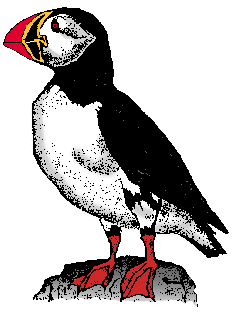
: any of several seabirds (genus Fratercula) of the northern hemisphere having a short neck and a deep grooved parti-colored laterally compressed bill
Illustration of puffin
Examples of puffin in a Sentence
Recent Examples on the Web
Examples are automatically compiled from online sources to
show current usage.Read More
Opinions expressed in the examples do not represent those of Merriam-Webster or its editors.
Send us feedback.
Rammagerðin Skip the puffin shops (what the locals call the run-of-the-mill souvenir stops) and set aside some time to roam around one of Rammagerðin’s locations—my favorite is tucked into Harpa, the opera house designed by Olafur Eliasson.—
Erika Owen,
Condé Nast Traveler,
19 Aug. 2026 On the popular puffin and lighthouse cruise, grab a pair of binoculars and watch the seabirds fly overhead and dive deep into the water.—
Morgan Rizzo,
Travel + Leisure,
16 Aug. 2026 Spot an incredible variety of wildlife, including sea lions, sea otters, porpoises, bald eagles and puffins.—
Wendy Altschuler,
Forbes.com,
15 Aug. 2026 Biological data on kingfishers, petrels, and puffins were reviewed.—
Mrigakshi Dixit,
Interesting Engineering,
9 July 2026 See All Example Sentences for puffin
Word History
Etymology
Middle English puffoun, poffin, pophyn "young of the shearwater Puffinus puffinus collected as food," probably borrowed from an unattested Middle Cornish cognate of Breton (Léon dialect) pocʼhan, pogan "puffin," (Basse-Cornouaille dialect) bocʼhanig (diminutive), probably a derivative of bocʼh "cheek" (Middle Cornish bogh), of uncertain origin
Note:
Breton bocʼh and Middle Cornish bogh may descend from a British Celtic borrowing from Latin bucca "lower part of the cheeks, jaw, puffed-out cheeks," unless this word is itself a Celtic loan.


 Copy Citation