: the fold of skin connecting the forelimbs and hind limbs of some tetrapods (such as flying squirrels)
2
: the fold of skin in front of the main segments of a bird's wing
Illustration of patagium
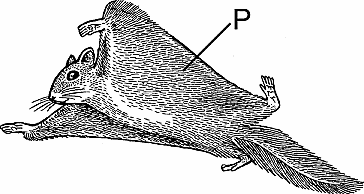
P patagium 1
Did you know?
In Latin, patagium referred to a gold edging or border on a woman's tunic, but in English its uses have been primarily scientific. It entered the English language in the early 19th century and was used by entomologists to refer to a process on the back of the foremost segment of an insect. Zoologists borrowed it as a word for the fold of skin of "flying" mammals and reptiles. Then ornithologists took the word to higher heights by the century's end, applying it to the forward part of the wings of birds.
Examples of patagium in a Sentence
Recent Examples on the Web
Examples are automatically compiled from online sources to
show current usage.Read More
Opinions expressed in the examples do not represent those of Merriam-Webster or its editors.
Send us feedback.
The extra fabric might be enough to minimally lengthen their jumps by providing a little more lift in the air—much like the patagium of a flying squirrel—and, in turn, more distance.—Jackie Flynn Mogensen, Scientific American, 12 Feb. 2026 Flying squirrels don’t have their own means of propulsion, like a bird or bat, but glide using a furry membrane called the patagium that connects at their wrists down to their ankles.—National Geographic, 21 Aug. 2020 Bats, however, use a thin, fleshy membrane called a patagium to provide lift, in place of feathers.—Nathaniel Scharping, Discover Magazine, 8 May 2019