: a tan or reddish canid (Canis dingo) of Australia that is often considered a subspecies (C. lupus dingo) of the wolf or a subspecies (C. familiaris dingo) of the domestic dog
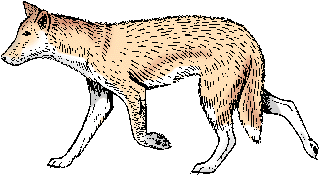
Illustration of dingo
Did you know?
An Australian wild dog, the dingo was apparently introduced from Asia 5,000–8,000 years ago. It has short, soft fur, a bushy tail, and erect, pointed ears. It is about 4 ft (1.2 m) long, including the 12-in (30-cm) tail, and stands about 24 in (60 cm) high. Its color varies between yellowish and reddish brown, often with white underparts, feet, and tail tip. Dingoes hunt alone or in small groups. They formerly preyed on kangaroos, but now feed mainly on rabbits and sometimes on livestock. Through competition for resources, they contributed to the extermination of the Tasmanian wolf and Tasmanian devil on the Australian mainland.
Examples of dingo in a Sentence
Recent Examples on the Web
Examples are automatically compiled from online sources to
show current usage.Read More
Opinions expressed in the examples do not represent those of Merriam-Webster or its editors.
Send us feedback.
Among plush kangaroos, dingoes and Tasmanian devils ready to be bought by parents of antsy children, a live brushtail possum waited in a gift shop at an Australian airport this week.—Brie Stimson, FOXNews.com, 21 Mar. 2026 Above the possum were bilbies, marsupials with rabbit-like long ears, and dingoes, Australia’s native dog.—ABC News, 18 Mar. 2026 Think of it as A Little Life, but with dingoes and willy-willies.—Literary Hub, 5 Mar. 2026 The euthanization program has stirred debate about how to manage the local population of dingoes, a sandy-colored canine believed to have first arrived in Australia 4,000 to 5,000 years ago.—CBS News, 28 Jan. 2026 See All Example Sentences for dingo
Word History
Etymology
Dharuk (Australian aboriginal language of the Port Jackson area) diŋgu